environment Politics: Desperation John Kerry Pi***ng into the wind
by Warren

2 comments
Meta
SiteMeter
Brighter Planet

Year 1, Month 1, Day 5: A Fax to John Kerry
Dear Senator Kerry,
I’ve lived in Massachusetts all my life, and I’m proud to have you as my senator. Thank you for your efforts in the area of global climate change, which is surely the most important issue facing America and the world. I wish I could say that America’s response to the climate crisis has been adequate and admirable; alas, that is not the case. We need to have administrative and political recognition that a meaningful policy on atmospheric CO2 is one that reduces atmospheric ppm to 350 or below; it is my understanding that both Kerry-Boxer and Waxman-Markey set a target of 450 ppm. Not enough; not enough; not enough. I am sufficiently cynical that the debacle in Copenhagen did not surprise me; I am sufficiently naive that I continue to believe that our system of government may be able to address this terrifying problem competently in the years to come. It had better; time is running out for all of us.
Yours Sincerely,
Warren Senders
I write my faxes out longhand, on the back of previously used paper. Fortunately I developed legible handwriting many years ago.
After I finish typing out the text for this post, I’ll copy it into Kerry’s email form, so he’ll get it digitally…and of course I’ll put the original hard copy in the mail to him. I got through to fax machines in all his offices except for Springfield, where it just rang and rang.
Kerry’s Fax numbers:
Washington D.C.:(202) 224-8525
Boston: (617) 248-3870
Springfield: (413) 736-1049
Fall River: (508) 677-0275
Why don’t you write to your senator?
environment Politics: Barack Obama climate change Pi***ng into the wind Things to do
by Warren
2 comments
Meta
SiteMeter
Brighter Planet
Year 1, Month 1, Day 4: A Fax to the White House
Dear President Obama,
The urgency of the climate crisis is without a doubt increasing by the day. Yet our national media persists in fostering the misconception that there is doubt about the causes, effects and possible remedies for anthropogenic global warming. And (tragically) they appear to be succeeding.
If meaningful climate-change treaties are to be ratified, if meaningful legislation is to be passed, it will be because
you fought for it in the arena of public opinion. Please, sir — use the presidential “bully pulpit” to make the case for America’s full participation in global efforts to combat catastrophic climate change. We must lead; if we cannot lead, at least let us lend a hand, rather than hinder the efforts of others.Thank you,
Warren Senders
This was handwritten on the back of a previously used piece of paper and faxed at around 10 am this morning. I’ll email it in a couple of minutes.
The White House FAX number is: 202-456-2461
The White House web page is:
http://www.whitehouse.gov/contact
Go tell them something. Keep the pressure on.
environment Politics: Desperation Pi***ng into the wind
by Warren
2 comments
Meta
SiteMeter
Brighter Planet
New Year’s Resolution:
One letter a day to media outlets or to one or more of our Elected Representatives.
The first three days’ worth went to the print media:
January 1:
The failure of our national media to cover the worsening climate crisis is surely the most important and tragic story of our time. An intrepid journalist could earn a Pulitzer, nay, a series of Pulitzers, by doing the in-depth reporting which revealed the extent to which our broadcast and print media have been coopted by the deep pockets of climate-change deniers. Alas, it’s not going to happen. As with all stories in which the media establishment has been a participant, there will never be any meaningful investigation. As glaciers melt, oceans become acidified, droughts become endemic, and local weather patterns become increasingly erratic and unpredictable, only one thing is absolutely certain: our media will continue to perpetuate the false notion that “there are two sides to every argument,” and the way to practice journalism is to give equal time to both parties.
Thus journalism becomes a travesty of itself.
Would an article on medicine be required to give equal column space to a proponent of the medieval theory of “humours”? Would an article on air travel be required to give equal column space to a turn-of-the-twentieth-century scientist’s assertion that heavier-than-air flight is impossible?
The decline in the number of Americans who believe global climate change is caused by human beings is not an abstract phenomenon, to be reported “impartially” in the pages of the nation’s press and on the news programs of our networks. No — that decline is the product of decades of irresponsibility on the part of that press and those networks. Our descendants (if there are any) will not be kind to the American media of this time, and with good and tragic reason.
January 2:
The terrifying implications of current climatological research are diluted by the measured language of scientific discourse. The relatively neutral term “climate change” is grossly misleading. A more appropriate word would be “climaticide.” The facts are readily available, but what is needed in the public sphere is not measured language, but a clarion call, an alarm warning all of us of a looming catastrophe. And here is where the print and broadcast media of our culture have profoundly failed humanity.
By insisting on a specious policy of false equivalence in which the statements of a few corporate-funded denialists “balance” the overwhelming majority of scientific evidence, our media have abdicated their responsibility to the truth. The simple fact is that if the world’s industrialized cultures do not radically and rapidly change their behaviors, the lives of our children, our grandchildren, and their children in turn will be unimaginably and horrifyingly different. By failing to inform the public, by failing to take this threat seriously (all the while exaggerating other, less significant problems), the media are now enabling the most serious threat that our planet has ever faced. Generations to come will look back at the excesses of the twentieth century in shame; they will see the media’s blind indifference to our toxic behavior for what it is: a crime of terrible magnitude.
Ignorance is excusable; willful refusal to engage with facts is not. The job of the news media is to engage with facts. Please do your job, so that we (all of us, everywhere) can do ours: trying to change our culture’s direction in time to preserve our world.
January 3:
Another blizzard will surely bring another round of blather from climate-change denialists: “Look! It’s snowing! That means there is no such thing as global warming!” It is difficult to find words to describe this level and degree of willful ignorance. One of the oft-repeated and oft-verified predictions of climate scientists is that as the global climate crisis worsens, local and regional storms will increase in intensity and frequency. Climatologists also predict that anomalous weather events (snow in May, seventy-degree days in February) will occur more often. While it’s not in the purview of scientific prognostication, it’s a sure bet that as long as the fossil-fuel industry continues funding denialist research, we will be subjected to increasing levels of mendacity and gullibility from their paid spokespersons. Our national media has completely abandoned any pretense of being “on the side of truth,” and in the long run, the human race will be the loser.
Tomorrow I’ll send some faxes to some politicians.
Education Jazz music: charlie banacos obituaries
by Warren
2 comments
Meta
SiteMeter
Brighter Planet
The Harmonics of Intensive Care: Charlie Banacos, R.I.P.
One of the country’s greatest music teachers died yesterday. Charlie Banacos taught jazz theory and ear-training for decades from his Massachusetts home; his students include many of the most famous names in jazz music.
His students have performed or recorded with Duke Ellington, Miles Davis, Maynard Ferguson, Chick Corea, Wynton Marsalis, David Liebman, Wayne Shorter, Michael Brecker and Joe Henderson, among others.
I never studied with Charlie, although many friends and colleagues did. Most importantly for me, the man who taught me most of what I know about jazz was a long-time student of his, so although we never met, I am part of his pedagogical lineage.
But that’s not what this post is about. When I heard about Charlie’s death (through a post on Facebook) I went to the “Charlie Banacos Students” FB page to learn more. And there I read a post called “Email from Charlie.”
environment Politics: climate change economic justice global warming greed neoliberalism
by Warren
leave a comment
Meta
SiteMeter
Brighter Planet
The Corporatocracy cannot save itself or us.
It really looks as if the only way we can save a recognizable planet is to create an unrecognizable economy:
…the problem of climate change legislation is economic as well as being political. We will discover a world order governed by an ideology called neoliberalism, in which a great surplus of capital, evident in the 1970s but having grown each decade since then, makes government into neoliberal government, government as a conduit for investor profits.
Neoliberal government, government under the conditions of dollar hegemony, global governance, the WTO, and so on, as have been increasingly applicable since the 1970s, is responsible mainly to the global neoliberal economy. If they hope to attract any business in their countries, governments around the world must provide an “appropriate business climate,” which in practical terms means they must cater to the profits system, the system which has produced 793 billionaires for our globe amidst a bottom half of humanity which lives off of less than $2.50/day. Thus the dramatic privatizations which have taken place over the last three decades around the world.
(snip)
If we are to grant the human race the freedom to think about devoting lifetimes to stewardship of Earth’s ecosystems, we will have to grant the human race a prior freedom FROM economic need. This means a rededication to the problems of food, clothing, and shelter, the problems of FUNDAMENTAL economic need (you know, nobody really needs a Mercedes) in light of the great initial retrenchment in resources which will go along with an international agreement to phase out the production of fossil fuels.
If we can’t agree upon an economy which provides everyone with the fundamentals, an economy of basic human rights, then what we’re likely to get are a bunch of last-minute, slapdash measures, committed in the expected panic of massive weather disruption and failing annual crops, which will hurt an awful lot of people. Imagine a carbon tax so onerous as to make air conditioning unaffordable in 110 degree (Fahrenheit) heat, or water restrictions which make it unaffordable for people to grow their own food under conditions of skyrocketing food prices. (Remember, most of the continental American west will be altered by the melting of the icepack atop the Sierras and Rockies, with the consequent drying up of water resources for Los Angeles, Phoenix, Las Vegas, and so on.)
There’s not much “on the other hand” that anyone can point to. But I think that an economy which reflected economic justice to the peoples of this world would probably rely a whole lot more on barter, and would be profoundly local. Right now, those of us who “own” our houses probably send those mortgage payments to corporate offices in some other state; our bills are paid by and to banks in Delaware or South Dakota or some other damn place; our salad greens come from California, our tasty Clementines from Spain.
If survival of the species depends on reinventing our economic systems, creating a way to live that’s better than what we’ve already tried…can we do it?
Indian music October 24 Action photoblogging: Dance Indian dance photoblogging
by Warren
leave a comment
Meta
SiteMeter
Brighter Planet
Aparna Sindhoor Dance Theater: New Photos
Ganesh Ramachandran took these photographs of the Aparna Sindhoor Dance Theater during the “Playing for the Planet” concert. I think they’re terrific.


Education Jazz music: Charlie Haden Dewey Redman Edward Blackwell Harmolodic Concept improvisation lecture-demonstration Ornette Coleman
by Warren
9 comments
Meta
SiteMeter
Brighter Planet
The Old And New Dreams Band: A Lecture-Demonstration
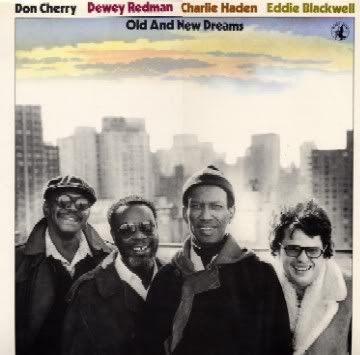
The first Old and New Dreams record on Black Saint has long been one of my Desert Island Discs. The rhythm section of Charlie Haden and Ed Blackwell serves up a magnificent polytextural stew in support of the melodic initiatives of Don Cherry and Dewey Redman; everybody plays brilliantly throughout.
In many ways, the work of this band always struck me as a purer presentation of Ornette Coleman’s concepts than many of Ornette’s performances. I mean by this that the shifting tonalities and re-centerings of melodic structure that are at the heart of Coleman’s work are in many ways easier to hear when the composer’s unique alto saxophone sound is not present. Ornette’s sonic presence is undeniable, but when he’s not there it becomes easier to think of the Harmolodic approach as a system that can be used by other musicians. When Ornette’s concept is used (and, as we hear below, explained) by other players, it is easier to separate the things they play from their performance personae. Ornette is such a dramatic and eccentric figure that it is tempting to explain Harmolodics as a species of musical crankery. When Don Cherry, Dewey Redman, Charlie Haden and Ed Blackwell interpret his music and influence, the importance and essentiality of Coleman’s Harmolodic Concept is indisputable.
They came to Harvard University in 1980 and played, if memory serves me correctly, at the Loeb Drama Center — an unusual venue. Hearing the band perform live in Cambridge was a truly wonderful experience; some memories from that gig still stand out (like watching Ed Blackwell create a huge blanket of rhythms without, apparently, moving his hands at all). I heard them again at a Cambridge jazz club (Jonathan Swift’s? I forget) a few years later, and they were brilliant then, too. But I digress.
One of the most memorable features of their time under Harvard’s auspices was the lecture-demonstration that Cherry, Redman and Haden gave at Adams House on February 29 (Blackwell was unavailable due to medical issues; IIRC he was doing daily dialysis). I recently digitized the recording of that lec-dem (made on a lo-fi boombox belonging to the drummer and drum-maker Betsy McGurk, who can be heard asking a few questions in the Q&A portion of the presentation) and I’m happy to present it here, along with a transcription (the result of many enjoyable late-night hours).
I have my own thoughts on what Ornette’s “Harmolodics” is all about (the fact that Ornette uses the word “love” a lot when he talks about his music theory is an interesting clue) and someday I’ll write them down and put them out here…but for now, here are Don Cherry, Dewey Redman and Charlie Haden, talking and playing about their music and their mentor, Ornette Coleman. Enjoy.
Jazz music Warren's music: Antigravity Bob Pilkington Dee Wood old stuff Phil Scarff Rick Barry Tom MacDonald
by Warren
2 comments
Meta
SiteMeter
Brighter Planet
Antigravity, 1980s edition. One of the best bands I’ve ever played in.
ANTIGRAVITY
Phil Scarff – tenor and soprano saxophones.
Bob Pilkington – trombone and percussion.
D. Wood – guitar and percussion.
Warren Senders – bass and percussion.
Rick Barry – percussion.
Tom MacDonald – drums.
Farewell Concert: September 23, 1983.
Old Cambridge Baptist Church, Cambridge, MA
This was an excellent band.

music October 24 Action Warren's music: Jose Feliciano Malvina Reynolds singer-songwriter Suzanne Vega Vijaya
by Warren
3 comments
Meta
SiteMeter
Brighter Planet
Playing for the Planet: Vijaya Sundaram
Vijaya Sundaram is a musician of superb abilities. An excellent composer and lyricist, she has a wide repertoire of material from many of the great songwriters. Over the past decade, however, she’s been away from the performance scene, pursuing a career as a teacher in a local public school, and spending a lot of time with our daughter Sharada.
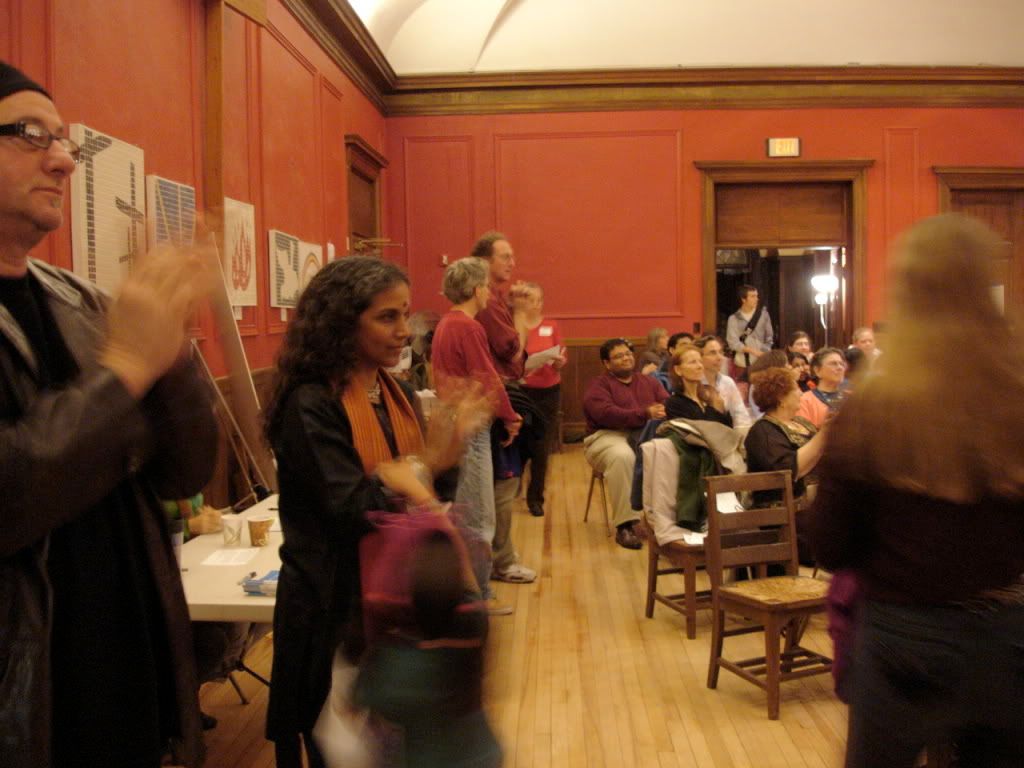
The “Playing for the Planet” concert actually saw her in three separate roles: as vocal accompanist for my set of khyal, as a member of the Agbekor Society, and as the singing and speaking MC of the evening.
music October 24 Action: Japan japanese music koto shakuhachi wabi-sabi
by Warren
leave a comment
Meta
SiteMeter
Brighter Planet
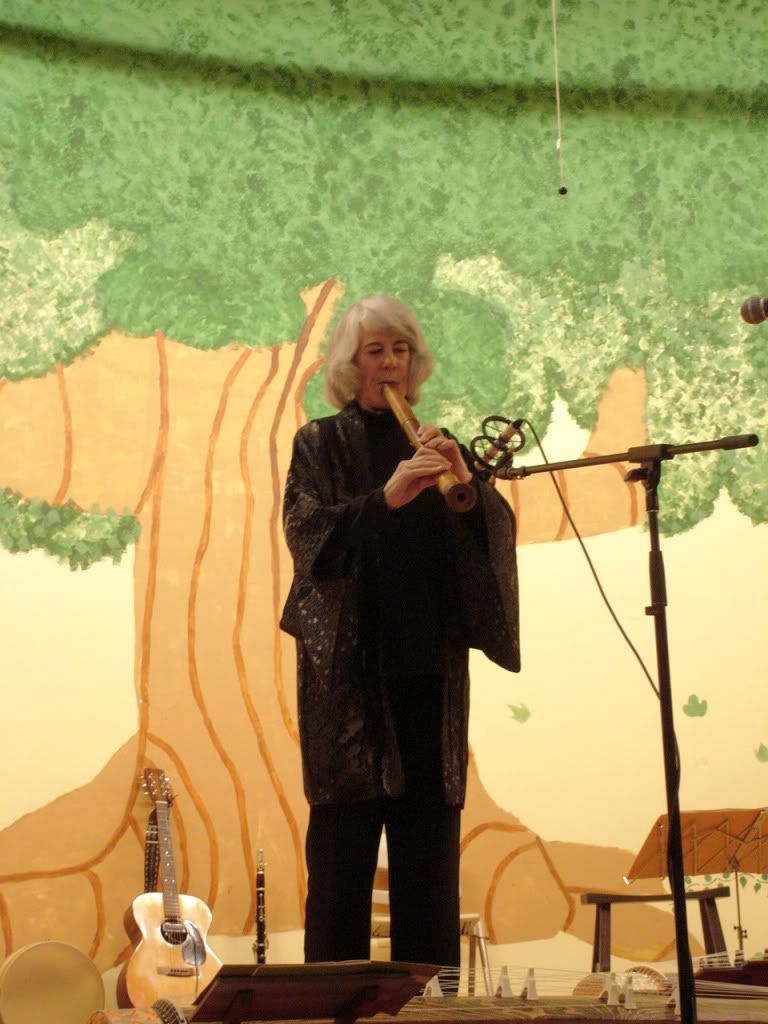
Playing for the Planet: Elizabeth Reian Bennett and Ayakano Cathleen Read
I have always been tremendously moved by the spare elegance of Japanese classical music. The modal environment triggers my affection for some of the popular Hindustani pentatonic ragas, while the rough edges, empty spaces and fantastically varied qualities of attack, sustain and decay force me into a more Cagean listening space.
This aesthetic of open space contrasts greatly with Indian music’s demand for a continuously saturated surface; as a khyal singer I am always engaged in that supersaturation, and I love it…but at times I envy the sparse and evocative economy of Japanese melodic lines — so different, and yet so similar.
Need I point out that Japan (an island nation) is particularly vulnerable to the rising ocean levels which will be triggered by catastrophic climate change?
The music presented on Saturday night by Elizabeth Reian Bennett, Ayakano Cathleen Read and Charles Hughes was a beautiful glimpse into an ancient tradition rarely heard today. I am deeply grateful for their performance.