music October 24 Action: Middle-Eastern music oud violin
by Warren

leave a comment
Meta
SiteMeter
Brighter Planet

Playing for the Planet: Beth Bahia Cohen’s set
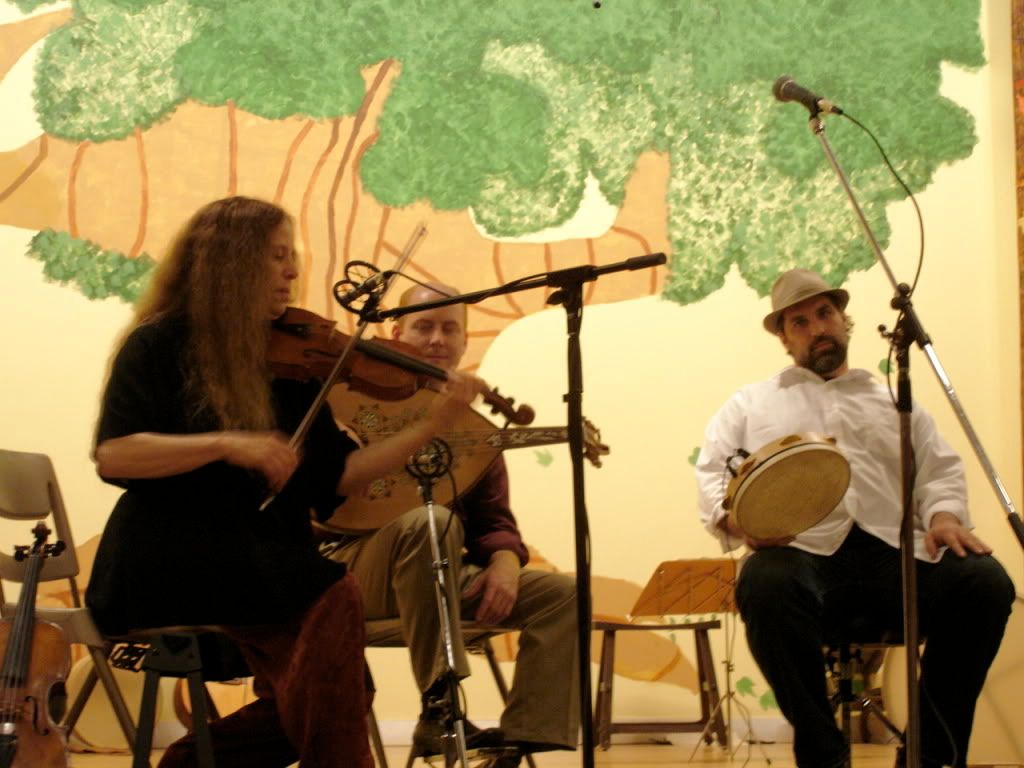
Beth Bahia Cohen and her accompanists opened the evening with a single twenty-five minute suite which included three separate melodies from different parts of the Middle East. The performance included lots of beautiful violin playing from Beth, a lovely oud solo from Mac Ritchey, and some great percussion from Todd Roach and Gabe Halberg. Rhythmically charged, passionate, lyrical…what a great way to start things off!
environment Indian music October 24 Action: Dance Indian dance
by Warren
1 comment
Meta
SiteMeter
Brighter Planet
Playing For The Planet: Aparna Sindhoor’s Set
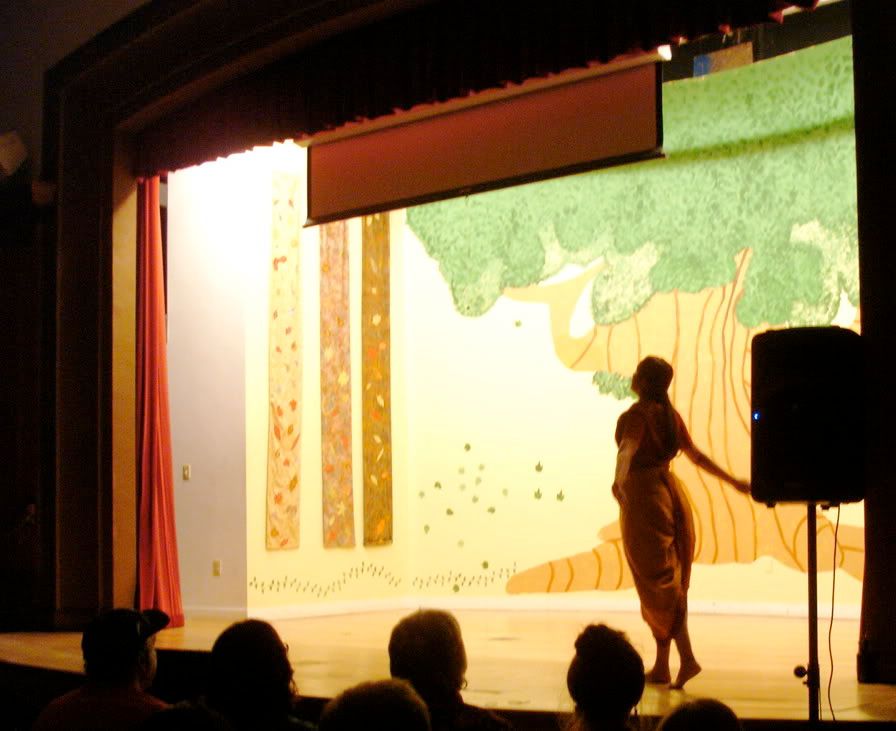
The fifth ensemble to perform (starting at around 9:20 pm) was the Aparna Sindhoor Dance Theater. The room lighting was wretched; even with the videocam on “nightshot” setting there was a lot of detail lost. But nevertheless, the power and genius of Aparna and her ensemble are evident in this video. This is a 25-minute excerpt from their long piece, “The Story and The Song,” about a young woman who could turn herself into a flowering tree and the prince who fell in love with her. The fact that there was a giant painted tree as a backdrop was purely serendipitous.
Here are four photographs (courtesy Hadley Langosey) and video (courtesy the Sony Cam mounted on a tripod, on top of the piano in the back of the room.). The first few seconds of the introduction were lost, but the rest of the performance is intact.
Jazz music Warren's music
by Warren
leave a comment
Meta
SiteMeter
Brighter Planet
Stuff from the Personal Vault: Laughing Moon
The first “band” I ever really gigged with was a free-improvisation ensemble called Laughing Moon. I gather that there is a progressive rock band out there somewhere using that name, which is nice.
I would bet good money, though, that they don’t sound anything like us.
We started out as an ad hoc improvisation group that for a few gigs included guitarist Joe Morris and a drummer named Chris Harvey. Scott Southworth, Sharrhan Williamson (who was then called Beverly or Bev) and I all connected with a wonderful drummer named Tim Roberts. That went on for about nine months; I don’t remember what happened, exactly, but we changed drummers.
Bryan Dennis was a terrific player with an unceasing flow of ideas. His shifting waves of time were tremendously influential in my early development as a bassist. The group played together in this configuration for perhaps a year, when it settled on its final incarnation as a trio.
By its very nature, the music of Laughing Moon was not chock-full of popular appeal. But I recently had occasion to check out one of our old recordings, and I was quite pleasantly reminded of what fun we had, and of how much fun our music was. Now that I’ve found the old recordings (and now that my hard drive has been upgraded so I have room for these projects), I’ve begun putting together some of them with photos.
Herewith, the first batch of Laughing Moon material, unheard since 1979. Thirty years ago, the three of us went into the broadcast studios at WBUR, on Steve Elman’s show “Spaces,” and broadcast a full set of our idiomatic free improvisations.
Indian music music: 78s Gwalior gharana khyal Ramakrishnabua Vaze
by Warren
5 comments
Meta
SiteMeter
Brighter Planet
A Blast from the Past: Ramakrishnabua Vaze (1871-1945)
One of the greatest voices of pre-Independence India, Pt. Ramakrishnabua Vaze was born in 1871:
…in a small village in Maharashtra…Vaze Bua lost his father soon after and was brought up by his mother. He studied for only a few years in school, his passion for music overtaking his interest in studies. With his mother’s help, he spent the next few years, moving around, taking lessons in music from several teachers. He was twelve when he was summoned home to get married and take up his duties as a householder. The newly married Vaze felt it improper to depend upon his mother for financial support and decided to take off on foot, with no particular destination and only the pursuit of music on his in mind.
Link
Note that at age twelve, he decided it was improper to depend on his mother…so he presumably left his wife (who was presumably even younger) at home and went out a-wandering.
At the time, all roads led to Gwalior, where the young man eventually became a disciple of Ustad Nissar Hussain Khan (note: this is not the Nissar Hussain Khan of Rampur-Sahaswan fame). The typical spate of privations, indignities and unswerving dedication eventually led to a level of musicianship and artistry that continues to amaze and inspire.
“His performances were always lively and intellectually stimulating. His layakari was flawless , his taans had clarity and force and he would leave his audience spellbound. He was responsible for bringing many little known ragas to light and as a composer, his specialty was bandishes in fast tempo.” Link
Here are a few of Vazebua’s wonderful short recordings, made during the heyday of 78 rpm discs in India. I’ll add more as I get around to it.
Enjoy!
Jazz music: Bob Moses John McLaughlin Keith Jarrett McCoy Tyner Mingus music photoblogging Sun Ra
by Warren
3 comments
Meta
SiteMeter
Brighter Planet
Jazz Photoblogging
I love photographing musicians — probably because I’m a musician myself, and it’s a wonderful challenge to capture some of the immediacy of live performance on film.
There have been two times in my life when I was really active in music photography. Once in the mid-1980s when I was living in India, and had the chance to get pictures of many of the Subcontinent’s greatest artists in concert, in rehearsal, and in private. And once in the mid-1970s when I was still in high school and had access to the school darkroom…and I took the Miranda SLR my father had given me to dozens of jazz concerts.
I had made a firm decision that I would not use flash; I did not wish to disturb the musicians by popping flashbulbs while they played. So I used high-speed film, underexposed and overdeveloped (a procedure known as “pushing” – I used Tri-X, pushed to ASA 1600, for all you b&w old-timers out there).
I got some good results, too. Here are a few images I’m particularly happy with:
Indian music music: Anant Manohar Joshi Gwalior gharana Indian music khyal music musical history
by Warren
leave a comment
Meta
SiteMeter
Brighter Planet
A Blast from the Past: Anant Manohar Joshi (1881-1967)
Here are four short performances by Pandit Anant Manohar Joshi, also called “Antubuwa.” Disciple of Balakrishnabua Ichalkaranjikar and “Bhugandharva” Ustad Rahmat Khan. Guru of Dr. S.N. Ratanjankar; father and guru of Pandit Gajananrao Joshi. Anant Manohar Joshi was born in Kinhai village, March 8, 1881. His father Manoharbuwa had learned classical styles from Raojibuwa Gogte of Ichalkaranji, and became a court musician at Aundh. He died when Anant was seven. Antubuwa became one of the top-most performers of traditional Gwalior style khyal, although he never achieved the fame of his guru-bhai, Vishnu Digambar Paluskar. “A powerful voice, daanedaar taans, and clear pronunciation of words characterised his rich and systematic style” according to Susheela Mishra (“Some Immortals of Hindustani Music”). He died in Bombay on September 12, 1967.
These short performances show Antubuwa at the end of his career. His voice is no longer flexible and his intonation is somewhat coarse, but the vigorous spirit remains.
environment music: climate change music Solomon Islands Sunda
by Warren
leave a comment
Meta
SiteMeter
Brighter Planet
What music will become extinct?
Every day, more bad news on climate change.
Fortunately, we’ve recently begun to initiate the process of agreeing on a framework for the development of a concept that will allow us to frame the discussion which will impact the structuring of a procedure for developing a methodology that makes it possible to begin to finally PAY SOME ATTENTION TO A GLOBAL CRISIS!
I am not a climate scientist. I’m a scientifically literate musician. Climate change scares me for dozens of reasons. And it makes me deeply and terribly sad.
With rising sea levels, many island nations will lose much of their land, or even cease to exist. Which brings me to tonight’s question:
What music will become extinct?
Indian music music: India photoblogging travelogue
by Warren
14 comments
Meta
SiteMeter
Brighter Planet
Musical Journeys in India: An Audio Travelogue
I must have been eight or nine when my Uncle Russell began taking me, once a month, to a lecture series at the university where he taught; each month a different world traveler would do a grownup version of show & tell. Slides, movies, anecdotes, facts. Exciting? I loved those outings, and I wish I remember more. But they certainly made their impression: as a boy, I knew that I wanted to travel, to see at least a few of those places first hand. Uncle Russ’ career as a management consultant for the Ford Foundation had taken him and his family to live in places far from the Boston suburbs where I grew up. One of those places was Hyderabad, India, and the souvenirs he and my aunt brought back from their years there were my first introduction to Indian culture.
I was seventeen when I encountered Indian music, and from the moment my ears opened to the sound of Hindustani ragas, I knew that this was something I had to do. Over the years that followed, I collected LPs and cassettes of Indian music with zeal; by the time I actually went to India, I had steeped myself obsessively in its classical and vernacular music. Now, thirty years later, I’ve got some show & tell of my own.
I have always liked John Cage…
…and in this video he is at his most enjoyable and charming:
Indian music music Warren's music: Boogie for Hanuman ego gratification reviews
by Warren
leave a comment
Meta
SiteMeter
Brighter Planet
I was egosurfing…
…and just found this review of “Boogie For Hanuman,” which I’d never seen before. Nice.
Most fusions of Indian music and jazz have served merely to add Asian accents to pieces that are distinctly Western. Often they have even been timid as jazz, aiming at pretty and soft moods that are as authentic as 1950s albums of Hawaiian music with a full orchestra. Most have employed Indian instruments playing in European time signatures rather than really exploring the possibilities of Hindustani scales and singing styles. Boogie for Hanuman is different. This album makes no compromises with the form of Indian classical music but does add jazz instruments and ideas about soloing and improvisation. The result is definitely not easy listening. Most of these pieces feature driving, complex percussion rhythms overlaid with a tangle of shifting melodies on violin, sitar, and various flutes. To someone unaccustomed to Indian music this can sound cacophonous, but repeated listenings reveal a sonic landscape of vast intricacy and subtle shades. The throbbing title cut is pretty accessible, with sitar and guitar interplay that the CD notes aptly compare to an Indian Dick Dale. The piece is over seven minutes long, but is not at all overextended — there are plenty of ideas here, and they’re deployed in such a way that the new listener is drawn in. From there things get gradually more complicated. “The Mobius Man” has multiple parts of the same theme playing on different instruments — some parts soothing, others hectic and busy, but all somehow integrated into one piece. “This Melody No Verb” has two themes played simultaneously, neither of which seems to suggest the other when considered separately. To describe the latter two tunes in this manner may make them sound like a music student’s composition class final — something bloodless, moodless, and technical — but all three are surprisingly easy listening. From here on things are more challenging — if “Dark House-Midday” was the first cut on the CD, listeners might not be inclined to check out the rest. Hopefully, newcomers to Indian music will have their ears attuned by the time this piece and “Weaving Time” come along, because the frantic, at times chaotic group improvisation takes some getting used to. “G-Mu-Nu” comes as close as this album gets to straight jazz, while “Ishmael” closes things out with boisterous, high-energy fusion. Boogie for Hanuman is a real rarity, a jazz-rock/world fusion album that is true to several sets of roots. The musically adventurous are advised to seek high and low, because this is one fine album. ~ Richard Foss, All Music Guide