India Photoblogging: Pune, 1985-1991
I took a lot of pictures while wandering around Pune in the mid-1980s and early 90s. I was using a Minolta SLR which I still have somewhere in a box; digital cameras have now taken over completely, so I haven’t looked through the lens of my 35mm camera in a very long time. Getting interesting results when you’re photographing scenes on an Indian street is not difficult; Indian streets are inherently interesting. Here are some of my favorites.
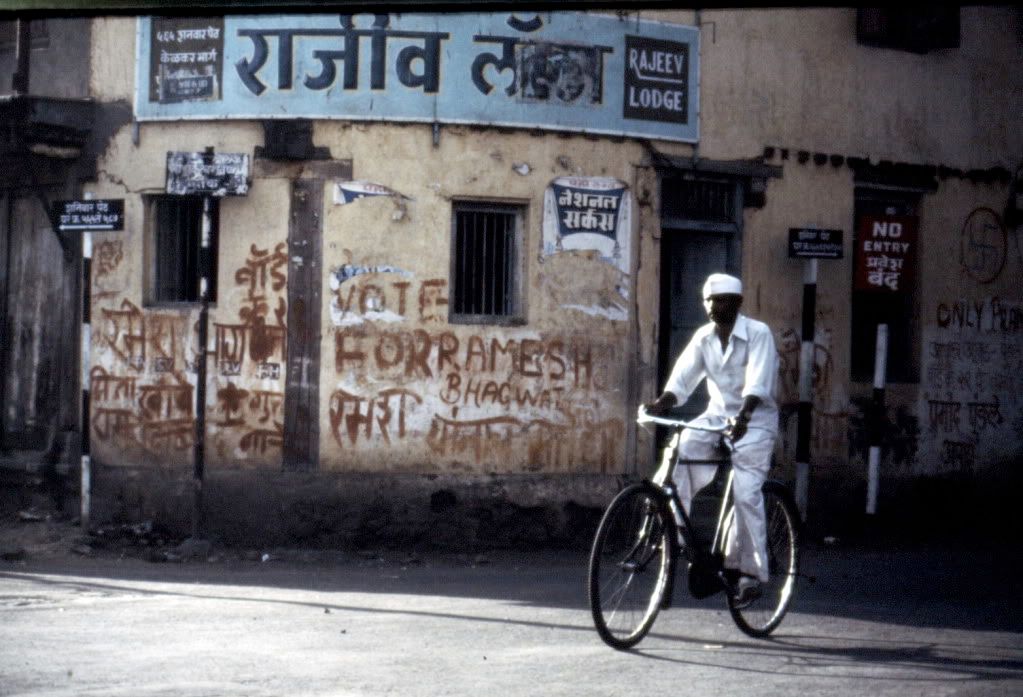
Somewhere in City section; I have a vague recollection this was in the vicinity of Appa Balwant Chowk, but that’s probably just my senility kicking in.

Shukrawar Peth, most likely. Probably somewhere close to Phule Market.
more »
Education Indian music music: practice riyaaz
by Warren

4 comments
Meta
SiteMeter
Brighter Planet

More Notes on Practicing
More material taken from my long-ago interview with my student Brian O’Neill. This discusses a practice technique called:
One Lick for Two Hours
Now, when you’re trying to build up speed and technical fluency the following exercise is very useful:
Compose a line (preferably in your head) 2 or 3 notes at a time… and keep building it up until you have something that covers the range that you want to cover and includes whatever kind of technical things you want to address (scalar segments, intervallic jumps, whatever).
Switch the metronome on (at around 60 bpm) and do the line in half notes, keeping the metronome not on the downbeats, but on the upbeats (2 & 4). That is, your sung articulations and the metronome’s strokes aren’t happening at the same time.
Go through the whole line in sargam, in neutral syllables, and in open vowels. If you’re an instrumentalist, go through the line using individual articulations on each note, then with a legato approach.
At which point you double the speed, so that the same line is now sung in quarter-notes, one note per pulse. The metronome needs to stay on the offbeats! Again, do it in sargam, neutral syllables and one or two open vowels.
Then go back to the original tempo and revisit that for a few iterations.
Now move the metronome up a click. If you have a digital metronome, go up by three or four beats per minute.
Repeat the process exactly as before, and when you’re done, move the metronome up another few bpm.
Eventually you’ll get up to mm 120, which is exactly double your starting tempo. Do the same exercise at that tempo…and then shift the metronome back to 60.
Only this time, maintain the same sung/played speed you had at mm 120 — with the metronome at the slower tempo. Now you’ll be singing the line in quarter and eighth notes relative to the speed of the metronome.
Repeat the alternation of “single” and “double” speed, with the metronome still on 2 and 4. (For extra credit, why does this practice work better when the metronome’s on the offbeats?). Keep going up by a few bpm at a time.
Eventually you’ll reach a point where you can go no further; a point where your technique is on the edge of failure.
Don’t stop the practice just yet. Instead, back down by a notch or two, repeat the material, then back down again. Do this eight or nine times, so that when you finally conclude the practice, you’re midway between your maximum speed and mm 60.
Stop.
Go take a walk or something. That’s enough of that practice for the day.
This is not a ten minute practice, this is a two hour practice. Two hours on one lick. The important thing is to keep that process going, all the way up and then retreat, incrementally, back down to about halfway from your original starting point.
This gradual up and down incrementation turns out to be very useful for building a solid technique at all levels of speed. It’s boring as hell, but it works a treat.
I remember sitting down to practice in my apartment in Pune. I was practicing Yaman, I sat down to practice, and I practiced one line for about an hour and forty-five minutes — using this metronome technique. Then I finished, I turned off the sruti box, and immediately my doorbell rang. And I went over and it was Atul, the sitarist in my ensemble. And he said, “That was incredible!” I said, “You were listening to the practice? How long were you there?” He said, laughing, “Oh, I arrived just before you began!” So he had been outside my door for an hour and forty five minutes listening to me go over the same thing and he was completely thrilled to have heard this practice. That was very interesting to me. Not everybody would find that interesting, but Atul did.
environment Politics: investments SEC
by Warren
leave a comment
Meta
SiteMeter
Brighter Planet
Day 28: Same Ol’, Same Ol’
Stimulated by the recently announced decision of the Securities and Exchange Commission that:
Companies must consider the effects of global warming and efforts to curb climate change when disclosing business risks to investors…
I thought I’d dash off a little missive to the Boston Globe saying what an excellent idea I thought it was.
Yesterday the business community got a good dose of realism when the SEC approved new guidelines requiring companies to include information on the impact of climate-change regulation in corporate filings. This is a message that the current administration is more serious about enforcing environmental-protection laws; under Bush, those laws were pretty universally ignored, leaving companies free to pollute. However, climate denialism is still very much a growth sector. Cynical and mendacious people eager to misrepresent an overwhelming scientific consensus are heavily funded by big oil and coal companies. It is time for the business sector to recognize the reality of global climate change and begin marshaling the resources of the private sector to help the world’s population prepare for the devastating effects of climaticide. Yesterday’s SEC ruling was a good step in the right direction, but we have a long way to go.
Warren Senders