Playing For The Planet…Goes Online!

Mark your calendars for a unique and exciting musical event!
On Saturday, May 9 at 7:00 (Eastern Time), please join us for the first Virtual Benefit Concert in the long-running Playing For The Planet series.
We’ll hear exquisite and heartfelt music from six different artists, representing six different musical traditions:
Durga Krishnan (South Indian Veena),
John Tyson & Miyuki Tsurutani
(European Renaissance music),
DoYeon Kim (Korean Gayegeum),
Ricardo Borsatto (Brazilian Choro),
Sunniva Brynnel (Swedish Folk), &
Ranjani Ramachandran (Hindustani khyal).
These semi-annual environmental benefit concerts started in 2009, and last December we celebrated our twentieth concert. Now, we’re looking forward to bringing you more such virtual events in the months to come.
To attend, simply make a donation of any amount ($20 suggested) at this link, and you’ll receive the log-in information you’ll need to join us on Zoom.
We at Playing For The Planet are excited to be bringing you these wonderful musicians, and very happy to be continuing this great tradition:
Great Music For A Great Cause.
Donate Here & Receive The Zoom Invitation

About the Artists:
South Indian veena master Durga Krishnan is a disciple of the legendary virtuoso, the late Dr. Chittibabu, whom she has accompanied in performance and on recordings, and is currently a student of Padmabhushan Sri Lalgudi G. Jayaraman, one of the greatest figures in contemporary Carnatic tradition. She holds the degree “Sangeetha Vidwan” (Scholar of Music) and is a certified teacher of Carnatic Music. A performer, teacher and composer of international repute, she has taught and concertized extensively throughout the world and is a very popular veena and vocal teacher in the Boston area; several of her students have won prizes at the Cleveland Thyagaraja festival.

Miyuki Tsurutani received her Master of Music degree from Osaka College of Music where she studied harpsichord with Hiroko Motooka, recorder with Toru Kamiya, and piano with Toshiko Tamura. She has performed in Japan, Taiwan, Australia, Italy, France, and Germany, Canada and in the United States at the University of Hawaii, the University of California, Tulane University, Bennington College, Capitol Early Music Festival in Washington D.C., the Killington Vermont Shakespeare Festival and the Boston Christmas Revels. She has been continuo player for the orchestra Boston Baroque’s residency at Boston University, The American Recorder Society and at masterclasses for The Boston Early Music Festival.
John Tyson is a winner of the Bodky International Competition, the Noah Greenberg Award, and a former student of Frans Bruggen. He has appeared as soloist in Italy, France, Germany, Spain, England, Scotland, Chile, Canada, Japan, Taiwan, and Australia and throughout the United States, as well as with major ensembles in Europe and the US. Tyson has recorded for Erato, Harmonia Mundi, Sine Qua Non, Titanic, and Ventadorn Records, and with Boston’s Handel & Haydn Society under Christopher Hogwood. His solo CD, “Something Old, Something New” features Baroque and contemporary music for recorder and strings. A recognized expert in Renaissance music and improvisation, Tyson is director of the Renaissance music and dance ensemble Renaissonics and is a member of the pop/classical/world music band Universal Village. He is director of the Corso di Flauto Dolce in Tuscany, Italy and has been a director of the Université d’Eté; Vivoin, France and music director of the Historical Dance Foundation of New York. John has premiered concerti for recorder and orchestra written for him: “Ventania” by jazzman Hermeto Pascoal, “Triptych,” by Chilean-born composer and conductor David Serendero for the 30th anniversary of his orchestra Reinisches Collegium Musicum in Wiesbaden, Germany, and a Double Concerto by Giorgio Pacchioni.
Tyson is on the faculty of the New England Conservatory of Music and has taught at the Corso Internazionale di Musica Antica in Urbino, Italy, and was Chair of the Department of Historical Performance at Boston University. He is also an Emerson Instructor at the Massachusetts Institute of Technology. In collaboration with The American Recorder Society and the National Endowment for the Arts, he produced an instructional video for recorder teachers entitled “Recorder Power!” Tyson has been Artist in Residence at Northeastern University, guest soloist at the Montréal International Recorder Festival and has taught at the Berklee College of Music, Boston Conservatory, Brandeis University, University of Connecticut, the National Center of Afro American Artists, the Museum of Fine Arts, Boston, and the Boston Symphony Orchestra’s Tanglewood Institute.

Do Yeon Kim plays the gayageum, a Korean silk-stringed zither. Her dream since the age of 12 has been to widely introduce Korean traditional music to the world on an international level. Do Yeon has received numerous awards in her native Korea, She was selected by the Korean Department of Culture to be one of the few gayageum musicians to tour with a youth group to Japan. She is the first player of the instrument to be admitted to study at the New England Conservatory. She comes from a rich background in traditional Korean folk music, yet her current music projects are quite multi-dimensional. Over the past few years she has transcribed pieces from musical idioms such as tango, jazz, and Western classical music with remarkable results. An exceptional improviser, her musical vision and ability to adapt music forms not associated with her instrument is truly extraordinary.

Hailing from a musical family in his native Brazil, Ricardo Borsatta grew up hearing and playing the music of composers like Pixinguinha and Jacob do Bandolim. He studied with master guitarist Alessandro Penezzi, who would become one of his most important musical mentors. Subsequently, he was awarded the Latin American Scholarship at the prestigious Berklee College of Music, earning a Degree in Jazz Composition and Performance. In Boston, he founded the Choro ensemble “Os Bohêmios”, which became the most important Choro group in New England area at that time. With musicians from five different countries, the quintet was an important part of Ricardo’s dream of disseminating his Choro heritage in the United States.

Originally from Sweden, Sunniva Brynnel is an accordionist, vocalist and composer within jazz, improvised music and folk music, coming from a lineage of seven generations of female musicians. Her mother – a Swedish folk singer – is one of her major influences. Since coming to the Boston area to complete a degree in Contemporary Improvisation at New England Conservatory, she has collaborated and performed with many artists, including Night Tree, Blå Dager, and Druids & Androids.

Ranjani Ramachandran is a prominent Hindustani classical vocalist specializing in the khayal genre and has earned wide acclaim for her performances in India and abroad. Trained in both the Gwalior and Jaipur gharana gayakis, Ranjani is a versatile musician equally at ease rendering other forms such as thumri, dadra and soulful bhajans. She has also carved a unique niche with her active engagement in pedagogy and research in music. Ranjani was initiated into Hindustani music at a young age by her mother, Vijaya. She is a disciple of eminent artistes like Pt. Ulhas Kashalkar, (Late) Smt. Veena Sahasrabuddhe, (Late) Pt. Kashinath Bodas and Vidushi Girija Devi. Ranjani has received numerous prestigious awards and accolades including the Pt. Ramkrishnabua Vaze Yuva Gayak Puraskar; Surmani award from Sur Singar Samsad, Mumbai; Resident Scholarship of ITC Sangeet Research Academy, Kolkata; Fellowship for Young artistes; Junior & Senior Research Fellowship for doctoral studies instituted by the Government of India and Charles Wallace Research Grant (CWIT, UK). Ranjani has a Doctorate in vocal Hindustani music and is currently working as a faculty in the Department of Hindustani Classical Music at Sangit Bhavana, Visva-Bharati University, Santiniketan in West Bengal. She has also participated in inter-disciplinary projects with visual arts and has been engaged in collaborative research with ethnomusicologists in India and abroad. Ranjani is a graded artiste of All India Radio and Doordarshan and empanelled as a performing artiste for ICCR (Indian Council for Cultural Relations). Her noteworthy performances include Vishnu Digambar Jayanti Samaroha (New Delhi); ITC Sangeet Sammelan; Kalakshetra Annual Art Festival (Chennai); Pt. Kumar Gandharva Smriti Samaroha (Dewas); Nehru Centre (London); Palace Green Library, Durham University, UK; Basant Bahar, California, USA; “Sangeet Pratibha” of Sangeet Natak Academy; India Habitat Centre (New Delhi) and Goa Kala Academy amongst many others.

About 350MA.org and the Better Future Project
Co-founded by environmentalist and author Bill McKibben, 350.org is the hub of a worldwide network of over two hundred environmental organizations, all with a common target: persuading the world’s countries to unite in an effort to reduce global levels of atmospheric carbon dioxide to 350 parts per million or less. Climatologist Dr. James Hansen says, “If humanity wishes to preserve a planet similar to that on which civilization developed and to which life on Earth is adapted, paleoclimate evidence and ongoing climate change suggest that CO2 will need to be reduced from its current 400 ppm to at most 350 ppm.” (Dr. Hansen headed the NASA Institute for Space Studies in New York City, and is best known for his testimony on climate change to congressional committees in the 1980s that helped raise broad awareness of the global warming issue.) Activists involved in the 350 movement include Rajendra Pachauri (Chairman, Intergovernmental Panel on Climate Change), Vandana Shiva (world-renowned environmental leader and thinker), Archbishop Desmond Tutu (1984 winner of the Nobel Peace Prize and a global activist on issues pertaining to democracy, freedom and human rights), Van Jones, Bianca Jagger, Barbara Kingsolver and many more.
350MA.org is the Massachusetts Chapter of this worldwide advocacy group, and the hub for the Better Future Project, a Cambridge-based climate organizing nonprofit founded in January 2011. In spring 2012, Better Future Project staff began a series of meetings and conversations with fellow activists about the need for a grassroots climate network in Massachusetts. Those conversations grew out of many years of collaboration on 350.org actions and events, and they led to the creation of 350 Massachusetts for a Better Future as a volunteer-led, campaign-focused network.
Uncategorized: 350 benefit concert climate change music
by Warren

leave a comment
Meta
SiteMeter
Brighter Planet

June 8: Playing For The Planet — World Music Against Climate Change

On Saturday, June 8, the nineteenth “Playing For The Planet” benefit concert will showcase master musicians from three different musical traditions in a rare and joyful pan-cultural evening, with all proceeds going to benefit the environmental advocacy group 350MA.org. The lineup includes virtuoso multi-instrumentalist Lloyd Thayer; Swedish/Celtic music from Sunniva Brynnel & Yaniv Yacoby; and the brilliant young Hindustani vocalist, Samarth Nagarkar. The music begins at 7:00 pm, at The Community Church Of Boston, 565 Boylston Street (Copley Square), Boston. Admission is $20; $15 students & seniors. For information, please call 781-330-8032, or email theclimatemessage@gmail.com.
“…Senders possesses a gift for assembling fascinating programs.”
— Andrew Gilbert, The Boston Globe —
“Playing For The Planet: World Music Against Climate Change” is the nineteenth concert in an ongoing series of cross-cultural events produced by Boston-area musician and environmental activist Warren Senders. These concerts were conceived as a way for creative musicians to contribute to the urgent struggle against global warming. Their choice of beneficiary, 350MA.org, is focused on building global consensus on reduction of atmospheric CO2 levels — action which climatologists agree is necessary to avoid catastrophic outcomes.
Because the climate problem recognizes no national boundaries, the artists represent musical styles from three different parts of the globe, and share key musical values: listening, honesty, creativity, and respect. And, of course, they are all committed to raising awareness of the potentially devastating effects of global warming. It’ll be an incredible evening of powerful music — from some of the finest musicians in New England and the world.
Purchase tickets now from Eventbrite.
About The Artists
Lloyd Thayer puts the ‘multi’ in multi-instrumentalist, playing a mind-boggling assortment of stringed instruments including (but not limited to): 22-stringed Indian Chaturangui, Dobro and Weissenborn lap steel guitars, Turkish Oud, Saz and Cumbus, Ragmakamtar, Afghan Rabab and more.

A recovering street performer and determined songwriter, his indoor shows combine a mixture of American folk and blues with elements of Indian, Arabic, Turkish, and Southeast Asian musical ideas, sometimes all in the course of the same song!
“Thayer plays with prismatic imagination and an emotional depth that captivates. “
— Sing Out Magazine —
Accordionist/singer Sunniva Brynnel and bouzouki player Yaniv Yacoby met at the New England Conservatory, Boston. They have built a repertoire evenly divided between the folk musics of Sweden and Ireland, capturing the exquisite expression of both traditions with creativity, fidelity, and playfulness.

Originally from Sweden, Sunniva Brynnel is an accordionist, vocalist and composer within jazz, improvised music and folk music, coming from a lineage of seven generations of female musicians. Her mother – a Swedish folk singer – is one of her major influences. Since coming to the Boston area to complete a degree in Contemporary Improvisation at New England Conservatory, she has collaborated and performed with many artists, including Night Tree, Blå Dager, and Druids & Androids.
Yaniv Yacoby is a multi-instrumentalist, composer and computer scientist based in Boston. He graduated from Harvard in May of 2015, earning a B.A. in Computer Science and earned a M.M. in Contemporary Improvisation from New England Conservatory in 2016. Yaniv has collaborated with numerous musicians in the Boston area, including pianist Chase Morrin, fiddler Eric Boodman, and ensemble Blue Thread.
Samarth Nagarkar is a Hindustani classical vocalist, known for his captivating performances and traditionally rich music. One of the most creative khyaliyas of his generation, Samarth was trained in the strict guru-shishya tradition at ITC Sangeet Research Academy, Kolkata, under Pandit Ulhas Kashalkar and Pandit Dinkar Kaikini.

A torchbearer of his traditions, Samarth features in prominent music festivals and venues in India and abroad including The ITC Sangeet Sammelans, The United Nations, World Music Institute, Chhandayan All Night Concert, Ragas Live Festival at the Rubin Museum of Art, Kashinath Bodas Festival, The Winter Garden Festival and The International Fringe Festival.
He is a recipient of a Fellowship from the Ministry of Culture, Government of India and a President’s Award in the All India Radio National Music Competition. On June 8 he will be joined by Ramchandra Joshi (harmonium) and Naikaj Pandhya (tabla).
Purchase tickets now from Eventbrite.
About 350MA.org and the Better Future Project
Co-founded by environmentalist and author Bill McKibben, 350.org is the hub of a worldwide network of over two hundred environmental organizations, all with a common target: persuading the world’s countries to unite in an effort to reduce global levels of atmospheric carbon dioxide to 350 parts per million or less. Climatologist Dr. James Hansen says, “If humanity wishes to preserve a planet similar to that on which civilization developed and to which life on Earth is adapted, paleoclimate evidence and ongoing climate change suggest that CO2 will need to be reduced from its current 400 ppm to at most 350 ppm.” (Dr. Hansen headed the NASA Institute for Space Studies in New York City, and is best known for his testimony on climate change to congressional committees in the 1980s that helped raise broad awareness of the global warming issue.) Activists involved in the 350 movement include Rajendra Pachauri (Chairman, Intergovernmental Panel on Climate Change), Vandana Shiva (world-renowned environmental leader and thinker), Archbishop Desmond Tutu (1984 winner of the Nobel Peace Prize and a global activist on issues pertaining to democracy, freedom and human rights), Van Jones, Bianca Jagger, Barbara Kingsolver and many more.
350MA.org is the Massachusetts Chapter of this worldwide advocacy group, and the hub for the Better Future Project, a Cambridge-based climate organizing nonprofit founded in January 2011. In spring 2012, Better Future Project staff began a series of meetings and conversations with fellow activists about the need for a grassroots climate network in Massachusetts. Those conversations grew out of many years of collaboration on 350.org actions and events, and they led to the creation of 350 Massachusetts for a Better Future as a volunteer-led, campaign-focused network.
About the Community Church of Boston
The Community Church of Boston is a free community united for the study and practice of universal religion, seeking to apply ethical ideals to individual life and the democratic and cooperative principle to all forms of social and economic life. We invite you to read on to discover more about us, join us one Sunday for a thought-provoking and joyful time, or contact the church to find out more about our community: info@communitychurchofboston.org
Purchase tickets now from Eventbrite.
India Indian music music Personal vocalists Warren's music
by Warren
leave a comment
Meta
SiteMeter
Brighter Planet
University of Southern Maine, May 5, 2023
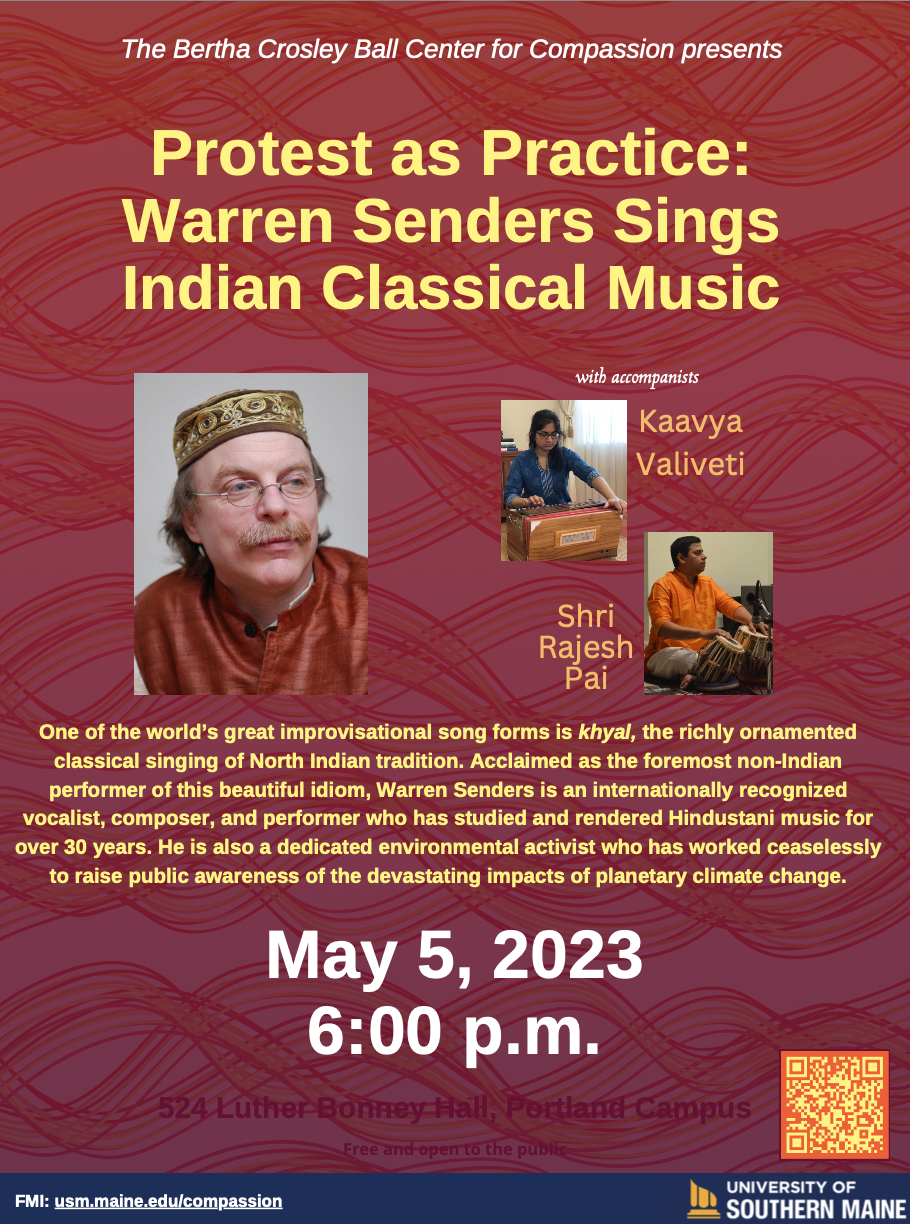
Earlier this year I gave my first public concert since before COVID. I had been invited to sing at the Bertha Crosley Ball Center for Compassion at the University of Southern Maine in Portland, and we wound up having a program almost concurrently with their Commencement.
Harmonium accompaniment was provided by Kaavya Valiveti and Rajesh Pai was on tabla. This was a very sympathetic team and I felt quite relaxed.
I opened with a full-length Puriya Kalyan. Vilambit: Hovana laagi saanjh / Drut: Jawoon tore charan.
The first half finished with one of my favorite light pieces, the Pahadi geet Jyuda kinjo dolna.
After the interval I started off with a two-parter in Hindol. The medium teentaal bandish Hori khelata hai giridhari is a great vehicle for bol-bant, and Rajesh and I got into some enjoyable rhythmic play. The drut composition Sundara aati chatur naar in ektaal has a very nice lilt.
The penultimate item was a tarana in Khamaj. This is an old traditional Gwalior cheez with some nice pakhawaj bols in the last line of the antara.
And I ended with Jamuna ke teer in Bhairavi.
I really enjoyed this concert. Though the audience was mostly newcomers to the music, they listened with great sympathy and feeling. There were several old friends there, including one person I’d last seen in 1976(!).
If for some reason you want to listen to the entire thing from beginning to end, with the introduction by Vaishali Mamgain and all of my remarks, here it is as a single uninterrupted file.
benefit concerts benefit concerts environment music Uncategorized: 350 activism benefit concert Better Future Project climate change Indian music Jazz khyal Middle-Eastern music music Raga violin
by Warren
9 comments
Meta
SiteMeter
Brighter Planet
December 7: Playing For The Planet — World Music Against Climate Change
The twentieth “Playing For The Planet” benefit concert showcases master musicians from three different musical traditions, in a benefit for the environmental advocacy group 350MA.org.

Featured performers include the cross-cultural violin master Beth Bahia Cohen, the Hindustani singing of Warren Senders, and the intimate jazz improvisations of Stan Strickland & Josh Rosen.
The music begins at 7:00 pm, at The Community Church Of Boston, 565 Boylston Street (Copley Square), Boston. Admission is $20; $15 students & seniors. For information, please call 781-330-8032, find us on our Facebook event page, or visit the event website at www.warrensenders.com.
Online ticket purchasing is available through Eventbrite.
About The Artists

Pianist/percussionist Josh Rosen and saxophonist/flautist/vocalist Stan Strickland are two of New England’s most loved and respected jazz musicians. They have been performing together since 2007, creating a intimate, spontaneous music that showcases their deep rapport with one another and with their listeners.
“Finishing each other’s thoughts and phrases as these tunes wend their way from churchy soul-jazz to more abstract precincts, Rosen and Strickland are more than just in sync — they often sound like a single musician playing two instruments.” – Boston Herald
“With the soul of an improv jam session, these two are one of the tastiest new treats to come along in a while.” – Midwest Record

Beth Bahia Cohen is of Syrian Jewish and Russian Jewish descent and has spent many years exploring the ways the violin and other bowed string instruments are played in Greece, Turkey, Hungary, and the Middle East. She plays several Greek lyras, the Turkish bowed tanbur and kabak kemane, the Egyptian rababa, the Norwegian hardanger fiddle, and more. She was a Radcliffe Bunting Fellow and has been the recipient of many travel and research grants, including an NEA/Artists International grant to study the classical music of Turkey.
In addition to performing throughout the U.S., she teaches workshops and ensembles on Middle Eastern, Eastern European, Greek and Turkish music in conservatories and universities throughout the U.S as well as teaching privately in her studio in Watertown. She performs solo concerts of traditional and original music on various bowed string instruments from many countries (The Art of the Bow), as well as concerts exploring traditional Jewish music from all over the world.

One of the world’s great improvisational song forms is khyal, the richly ornamented classical singing of North Indian tradition. Accompanied by the harmonium of Kaavya Velivati and the tabla of Harsha Hampapura, Warren Senders weaves a hypnotic tapestry of sound in his renditions of traditional ragas.
Acclaimed as the foremost non-Indian performer of this beautiful idiom, Senders lived in India for many years, learning the khyal style from master teacher Pt. S.G. Devasthali. He has performed throughout the world, enrapturing audiences and critics with a unique combination of authenticity and originality.
Online ticket purchasing is available through Eventbrite.
About 350MA and 350.org
Co-founded by environmentalist and author Bill McKibben, 350.org is the hub of a worldwide network of over two hundred environmental organizations, all with a common target: persuading the world’s countries to unite in an effort to reduce global levels of atmospheric carbon dioxide to 350 parts per million or less. Climatologist Dr. James Hansen says, “If humanity wishes to preserve a planet similar to that on which civilization developed and to which life on Earth is adapted, paleoclimate evidence and ongoing climate change suggest that CO2 will need to be reduced from its current 400 ppm to at most 350 ppm.” (Dr. Hansen headed the NASA Institute for Space Studies in New York City, and is best known for his testimony on climate change to congressional committees in the 1980s that helped raise broad awareness of the global warming issue.) Activists involved in the 350 movement include Rajendra Pachauri (Chairman, Intergovernmental Panel on Climate Change), Vandana Shiva (world-renowned environmental leader and thinker), Archbishop Desmond Tutu (1984 winner of the Nobel Peace Prize and a global activist on issues pertaining to democracy, freedom and human rights), Van Jones, Bianca Jagger, Barbara Kingsolver and many more.
350MA.org is the Massachusetts Chapter of this worldwide advocacy group, and the hub for the Better Future Project.
About The Community Church Of Boston
The Community Church of Boston is a free community united for the study and practice of universal religion, seeking to apply ethical ideals to individual life and the democratic and cooperative principle to all forms of social and economic life. We invite you to join us one Sunday for a thought-provoking and joyful time, or contact the church to find out more: info@communitychurchofboston.org
environment Indian music music: 350.org 350ma benefit concert Bill McKibben Korea Nepal
by Warren
leave a comment
Meta
SiteMeter
Brighter Planet
December 8, 2018: Playing For The Planet — World Music Against Climate Change

 On Saturday, December 8, the eighteenth “Playing For The Planet” benefit concert will showcase master musicians from three different musical traditions in a rare and joyful pan-cultural evening, with all proceeds going to benefit the environmental advocacy group 350MA.org. The lineup includes Do Yeon Kim, the contemporary virtuoso of the Korean gayageum, Nepalese sarangi master Shyam Nepali, and New England’s great exponents of American folk tradition, Lorraine Lee & Bennett Hammond. The music begins at 7:00 pm, at The Community Church Of Boston, 565 Boylston Street (Copley Square), Boston. Admission is $20; $15 students & seniors.
Online ticket purchasing
available through Eventbrite.
This concert is the eighteenth in an ongoing series of cross-cultural events produced by Boston-area musician and environmental activist Warren Senders, conceived as a way for creative musicians to contribute to the urgent struggle against global warming. Their choice of beneficiary, 350MA.org, is focused on building global consensus on reduction of atmospheric CO2 levels — action which climatologists agree is necessary to avoid catastrophic outcomes. Because the climate problem recognizes no national boundaries, the artists represent musical styles from three different parts of the globe, and share key musical values: listening, honesty, creativity, and respect. And, of course, they are all committed to raising awareness of the potentially devastating effects of global warming. It’ll be an incredible evening of powerful music — from some of the finest musicians in New England and the world.
“…pleasant surprises and stimulation of the aesthetic synapses…
…an open-ended, floating, world music festival…”
— Steve Elman, ArtsFuse —
“…Senders possesses a gift for assembling fascinating programs.”
— Andrew Gilbert, The Boston Globe —
About The Artists
Lorraine Lee & Bennett Hammond
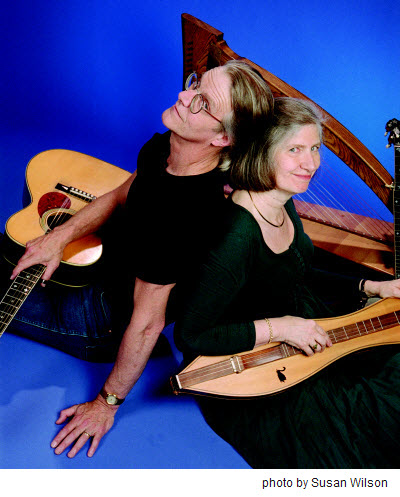 Lorraine Lee, renowned master of the Appalachian dulcimer, also plays banjo, mandolin and Celtic harp and is an expressive singer and songwriter. Bennett, a superb finger-style guitarist and recent convert to the five string banjo, names “the three Bs”, Bach, the blues and Buddy Holly, as major influences.
Together, The Hammonds are versatile musicians and engaging entertainers. Their warm stage presence is punctuated with wry humor, and their command of their instruments and musical genres is without flaw. The Boston Globe calls them “a dazzling, witty, eclectic, delightful duo.”
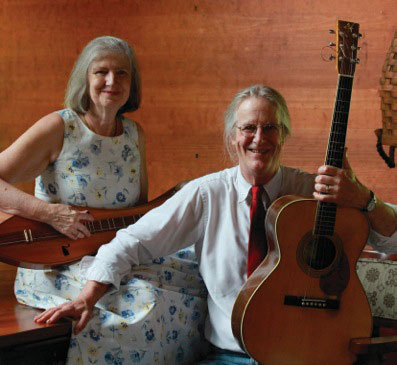 The Brookline-based duo’s repertoire ranges in style from classical through Celtic, blues and contemporary. They sing both traditional and original songs and can be heard on over thirty recordings as featured artists, or enhancing the work of performers including Archie Fisher, Lui Collins and Bob Franke. Christine Lavin and Heidi Mueller are among the artists who have covered Hammond originals.
Lorraine and Bennett’s most recent releases include Jingalo Gypsy, Rockafolky Banjo, and Lorraine’s Muddy River Suite.
On December 8, Lorraine and Bennett will be joined by special guest Dean Stevens.
“More than just good pickers, Lorraine and Bennett are singers with an ear for traditional and contemporary songs. They work seamlessly together, blending instruments and voices.”
— Golden Link Folk Society —
Do Yeon Kim
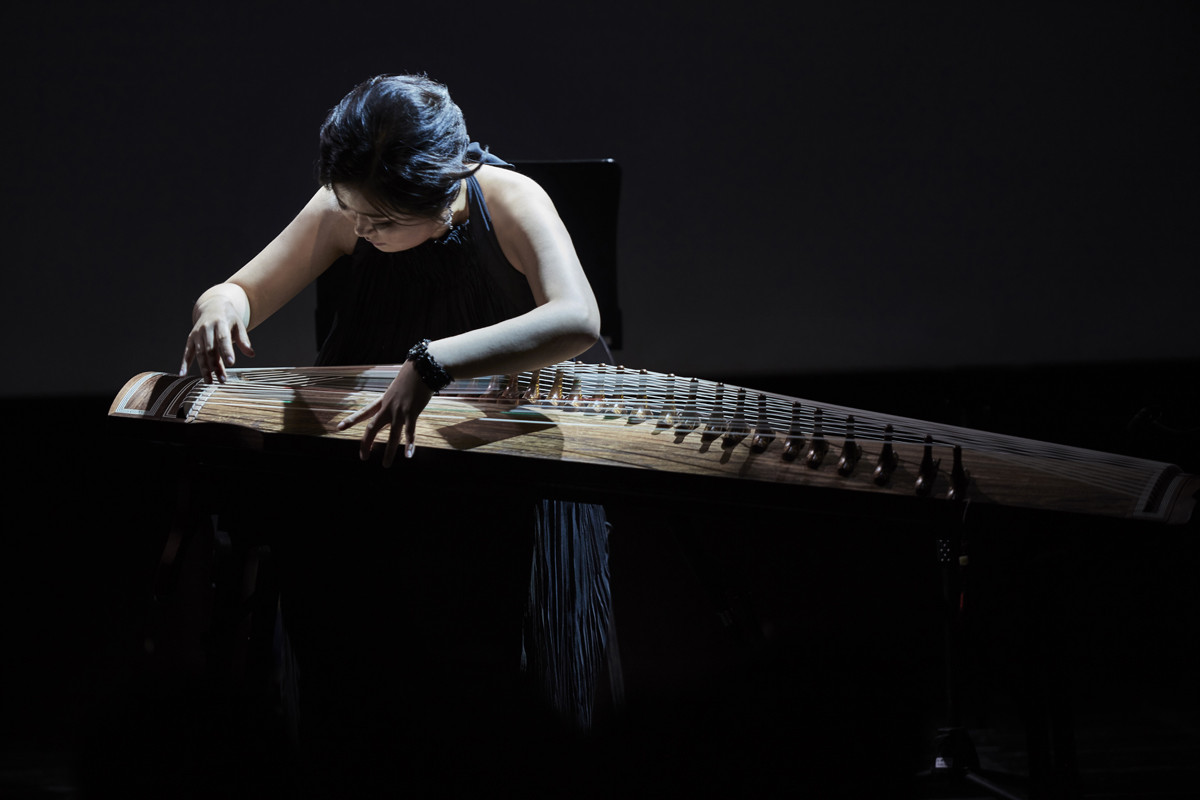
Do Yeon Kim plays the gayageum, a Korean silk-stringed zither. An early prodigy on the instrument, she has received numerous awards in her native Korea, and was selected by the Korean Department of Culture to be one of the few gayageum musicians to tour with a youth group to Japan.
 She is the first gayageum player at the New England Conservatory of Music, where she received a Masters degree in Contemporary Improvisation, following her undergraduate degree in Korean music. Do Yeon is committed to introducing the western world to the national instrument of her homeland and expanding the gayageum’s boundaries.
In addition to playing Korean traditional music, Do Yeon is an exceptional improvisor who has collaborated with musicians from many genres, including tango, jazz, and Western classical music. Her musical vision and ability to adopt styles and forms not associated with her instrument is truly extraordinary.
Shyam Nepali
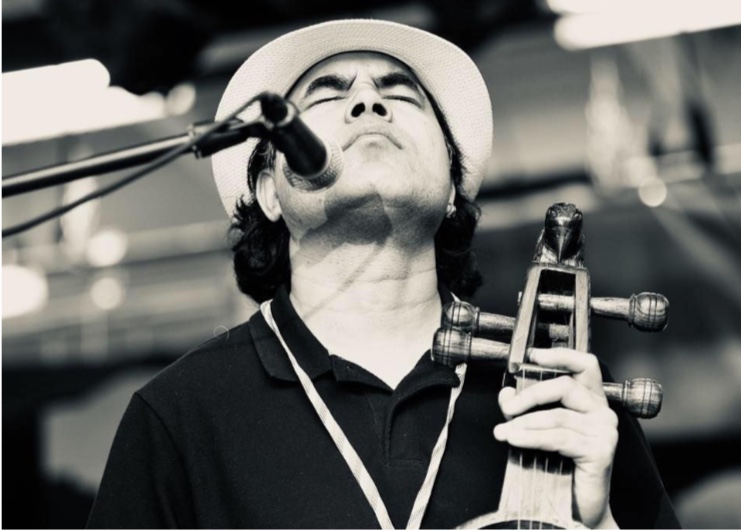
Hailing from the centuries-old Gandharba musical tradition of Nepal, Shyam Nepali been bringing the sounds of the Sarangi to audiences around the world for three decades. His superb musicianship has allowed the traditional sound of the Sarangi to travel in new directions, whether it’s blending the traditional folk music of Nepal with other styles or finding entirely new sounds through creative improvisation and collaboration. His virtuosity and musicianship allows him to fearlessly expand the Sarangi’s expressive capabilities with every note.
 Shyam has recorded and performed with artists such as Patti Smith, Tenzin Chogyal, and Abigail Washburn. An important teacher and mentor of the next generations of Sarangi players, he works with Project Sarangi in Nepal, and the Imagine Rainbow Project (Switzerland/Nepal), to foster the creative arts and keep the traditions alive.
The founder of the Himalayan Heritage Cultural Academy in Boston, MA, a platform for Nepali folk music and dance in the USA, Shyam has taught and mentored the newest generation of Sarangi players and folk musicians including members of the Nepali supergroups Kutumba, Sakchyam, Nayan, Manda, Lakchya, Shree Tara, and Lakhay. Awards and recognition of his significant contribution to Nepali folk music and the Sarangi around the world include the Mah Kwah Cha award from the government of Nepal, the Governor’s Citation from the Commonwealth of Massachusetts, and an honorary consulship from the Italian government.
ABOUT 350.org and 350MA.org
Co-founded by environmentalist and author Bill McKibben, 350.org is the hub of a worldwide network of over two hundred environmental organizations, all with a common target: persuading the world’s countries to unite in an effort to reduce global levels of atmospheric carbon dioxide to 350 parts per million or less. Climatologist Dr. James Hansen says, “If humanity wishes to preserve a planet similar to that on which civilization developed and to which life on Earth is adapted, paleoclimate evidence and ongoing climate change suggest that CO2 will need to be reduced from its current 400 ppm to at most 350 ppm.” (Dr. Hansen headed the NASA Institute for Space Studies in New York City, and is best known for his testimony on climate change to congressional committees in the 1980s that helped raise broad awareness of the global warming issue.) Activists involved in the 350 movement include Rajendra Pachauri (Chairman, Intergovernmental Panel on Climate Change), Vandana Shiva (world-renowned environmental leader and thinker), Archbishop Desmond Tutu (1984 winner of the Nobel Peace Prize and a global activist on issues pertaining to democracy, freedom and human rights), Van Jones, Bianca Jagger, Barbara Kingsolver and many more.
350MA.org is the Massachusetts Chapter of this worldwide advocacy group, and the hub for the Better Future Project.
The Community Church of Boston is a free community united for the study and practice of universal religion, seeking to apply ethical ideals to individual life and the democratic and cooperative principle to all forms of social and economic life. We invite you to read on to discover more about us, join us one Sunday for a thought-provoking and joyful time, or contact the church to find out more about our community: info@communitychurchofboston.org
Online ticket purchasing
available through Eventbrite.
environment India music Politics: 350.org benefit concert Cape Breton music climate change dumbeq fiddle Indian music Middle-Eastern music oud world music
by Warren
leave a comment
Meta
SiteMeter
Brighter Planet
Playing For The Planet: World Music Against Climate Change — June 2, 2018

Mark your calendars for one of the year’s most exciting musical events!
On Saturday, June 2, the seventeenth “Playing For The Planet” benefit concert showcases master musicians from three different musical traditions, in a benefit for the environmental advocacy group 350MA.org.
Come and hear Mal Barsamian and Charles Dermenjian performing Armenian and Turkish music, Gus LaCasse’s Acadian & Cape Breton fiddling, and a Hindustani performance by vocalist Ramchandra Joshi.
The music begins at 7:00 pm, at The Community Church Of Boston, 565 Boylston Street (Copley Square), Boston.
Admission is $20; $15 students & seniors.
Tickets are available online through eventbrite.
For further information, please call 781-330-8032.
“Playing For The Planet: World Music Against Climate Change” is the seventeenth concert in an ongoing series of cross-cultural events produced by Boston-area musician and environmental activist Warren Senders. These concerts were conceived as a way for creative musicians to contribute to the urgent struggle against global warming. Their choice of beneficiary, 350MA.org, is focused on building global consensus on reduction of atmospheric CO2 levels — action which climatologists agree is necessary to avoid catastrophic outcomes.
Because the climate problem recognizes no national boundaries, the artists represent musical styles from three different parts of the globe, and share key musical values: listening, honesty, creativity, and respect. And, of course, they are all committed to raising awareness of the potentially devastating effects of global warming. It’ll be an incredible evening of powerful music — from some of the finest musicians in New England and the world.
About The Artists
Mal Barsamian and Charles Dermenjian
Mal Barsamian’s musical career began when he was four years old playing the doumbek (hand drum) with his father Leo Barsamian at an Armenian picnic. Mal comes from a family of oud players starting with his grandfather, great-uncle, his uncle and of course his father. He has gone on to become a sought-after oud player (lute) and clarinetist as well as other instruments such as doumbek, guitar, bouzouki, and saxophone in Armenian, Greek, and Middle Eastern communities for forty years throughout the country.
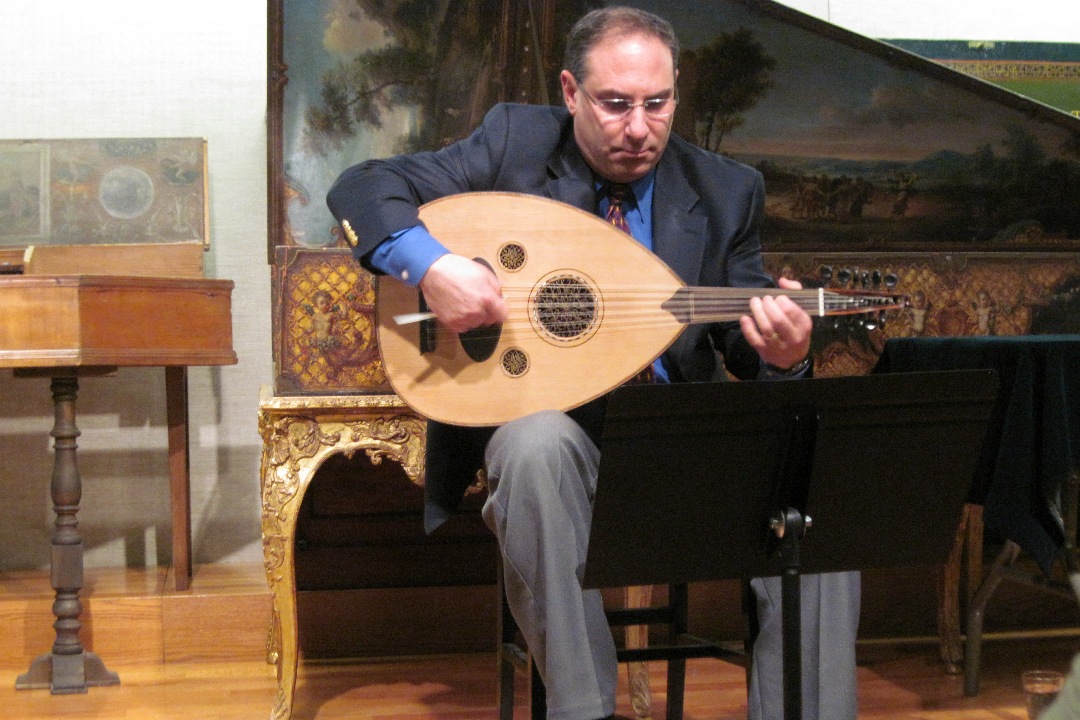
Mal Barsamian
He performed with the late Esber Korporcu, an important figure in Boston’s Middle-Eastern music community, and has also appeared with Mehmet Sanlikol’s Dunya organization. Mal is a specialist in music written by Armenian composers active in Istanbul during the later years of the Ottoman Empire. Also trained as a classical guitarist, he obtained his Bachelor’s and Master’s degrees in classical guitar performance studying with Robert Paul Sullivan from the New England Conservatory of Music.
Mal is on the applied faculty staff at Tufts University’s World Music Department, teaching oud, saxophone, clarinet and percussion, an applied faculty member at Boston College and also leads the Middle Eastern Ensemble at New England Conservatory of Music.
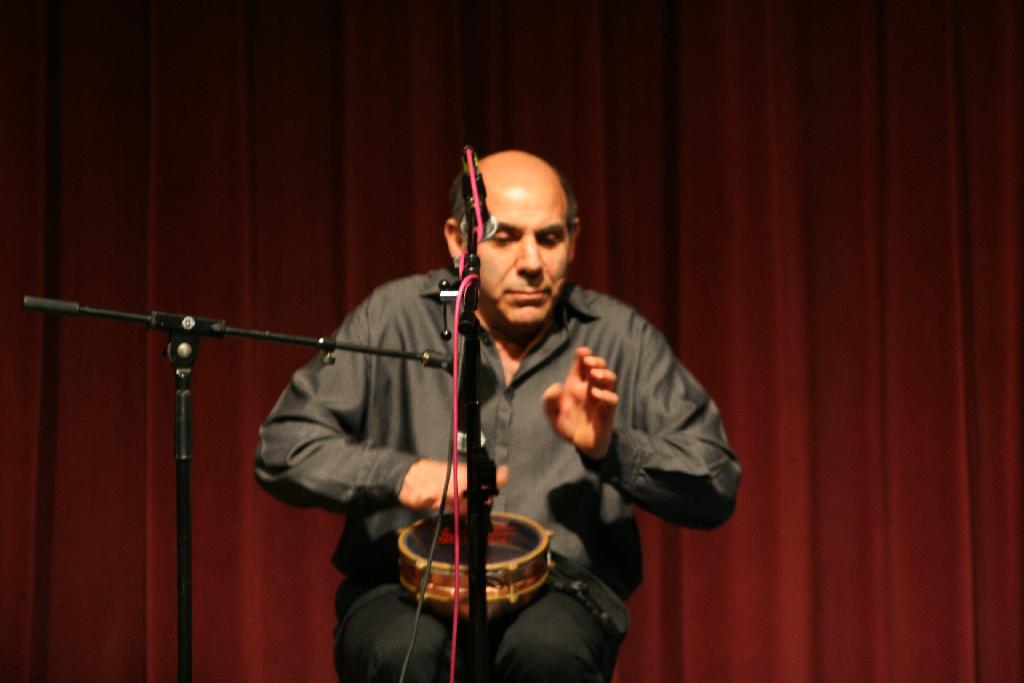
Charles Dermenjian
Charles Dermenjian plays percussion, featuring the doumbek, the most commonly played percussive instrument throughout Middle Eastern cultures, and has performed extensively both across the United States and abroad. In addition to playing with numerous Middle Eastern musicians, Charles has performed locally with Stan Strickland, as well as several Berkley College faculty. Aside from performing, Charles has devised and applied specific rhythmic teachings as a form of meditative group therapy.
Gus LaCasse
“…a natural-born fiddle player…whose energy would power a small city.”
— Peter Sutherland, Young Tradition Vermont —
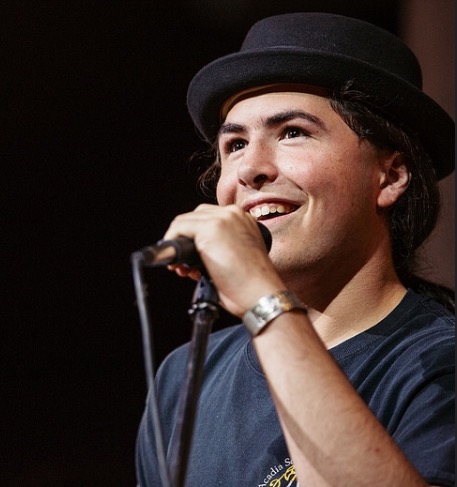
Gus LaCasse
A folk fiddler with both speed and savage energy, Gus La Casse’s repertoire reflects his innovative spirit and dedication to the Cape Breton and Acadian fiddle traditions, playing both standards of the genre and his original material. Based in Downeast Maine, Gus maintains an active performance schedule as a solo artist and with other musicians including guitarist Peter Lindquist, rock-to-world-music band Big Tree and a contra dance trio.
Gus’ music has also taken him beyond Maine. He was the 2014 student in residence at The Acadia School of Traditional Music, appearing on the Canadian international television broadcast from the Congrès Mondial Acadien 2014. He traveled to Ireland as part of the Young Tradition Vermont touring group in 2016, and has enjoyed playing the legendary Club Passim in Cambridge, MA.
Ramchandra Joshi
An accomplished vocalist and harmonium player, Ramchandra Joshi was introduced to the world of music at the age of 8 by his mother Smt Anjani Tilak, a disciple of Pt Manikbua thakursdas. He has trained with Smt. Tulika Ghosh, a disciple of Pt Gyanprakash Ghosh from Kolkata, at Sangeet Mahabharati Music Academy in Mumbai.
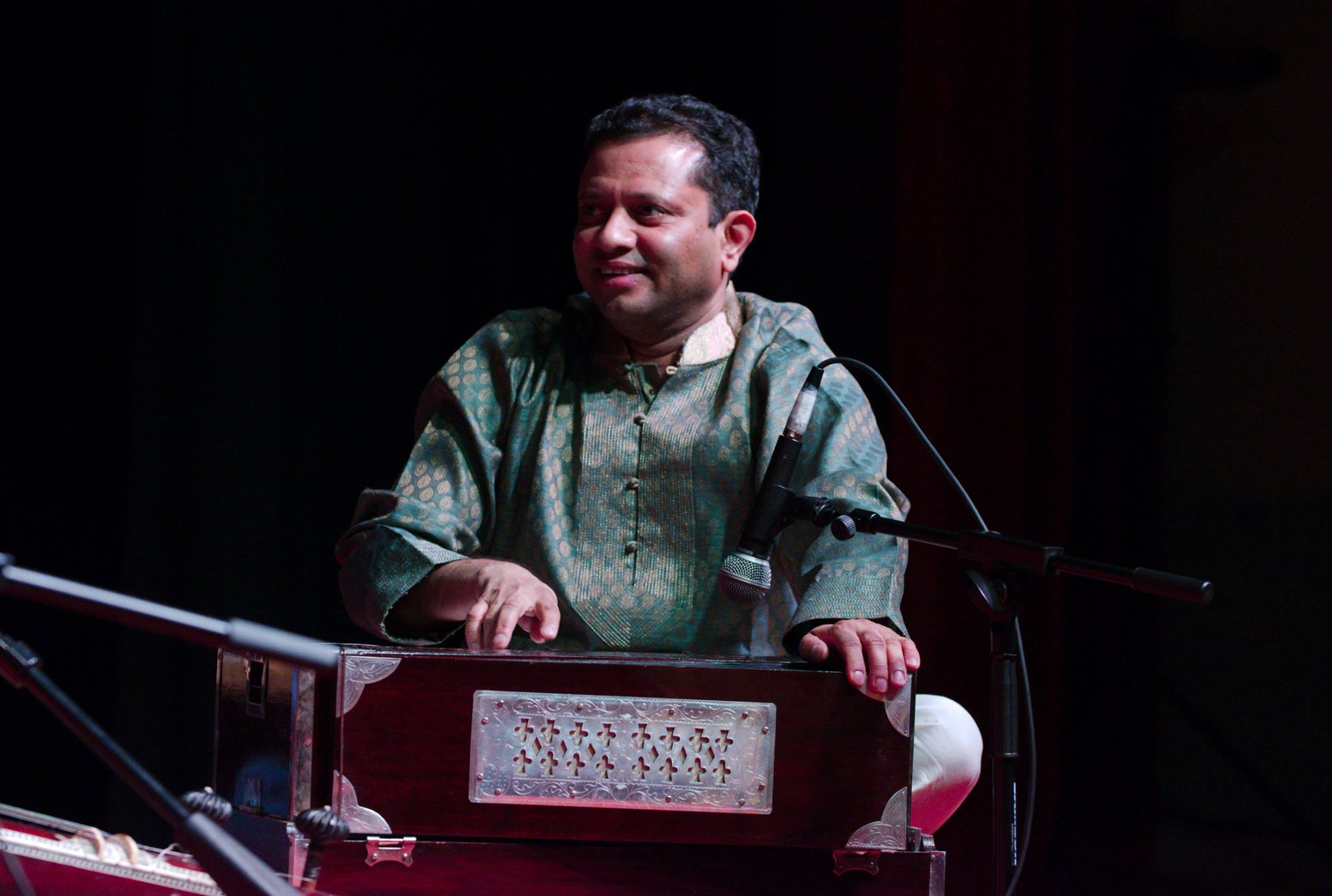
Ramchandra Joshi
Ramchandra Joshi’s Gayaki is inspired by the legendary vocalist from Gwalior Gharana Dr.Veena Sahasrabuddhe, with whom he performed on several occasions, notably the 1994 Malhar Festival at the Nehru Cente.
A specialist in khyal, thumri, natyasangeet, bhavgeet, bhajans and ghazals, he has toured extensively in India, USA, UK and Switzerland. Ramchandra holds B+ Grade from All India Radio.
As a harmonium accompanist Ramchandra has performed alongside many senior and junior artists like Arati Ankalikar-Tikekar, Konkana Banerjee, Sanhita Nandi,Girish Chatterjee, Sandeep Bhattacharya, Rahul Deshpande, Mahesh Kale, and many more. He has lived in the United States since 2003.
On June 2, Ramchandra Joshi will be accompanied by Sri Rajesh Pai on tabla.
About 350.org and 350MA.org
Co-founded by environmentalist and author Bill McKibben, 350.org is the hub of a worldwide network of over two hundred environmental organizations, all with a common target: persuading the world’s countries to unite in an effort to reduce global levels of atmospheric carbon dioxide to 350 parts per million or less. Climatologist Dr. James Hansen says, “If humanity wishes to preserve a planet similar to that on which civilization developed and to which life on Earth is adapted, paleoclimate evidence and ongoing climate change suggest that CO2 will need to be reduced from its current 400 ppm to at most 350 ppm.” (Dr. Hansen headed the NASA Institute for Space Studies in New York City, and is best known for his testimony on climate change to congressional committees in the 1980s that helped raise broad awareness of the global warming issue.) Activists involved in the 350 movement include Rajendra Pachauri (Chairman, Intergovernmental Panel on Climate Change), Vandana Shiva (world-renowned environmental leader and thinker), Archbishop Desmond Tutu (1984 winner of the Nobel Peace Prize and a global activist on issues pertaining to democracy, freedom and human rights), Van Jones, Bianca Jagger, Barbara Kingsolver and many more.
350MA.org is the Massachusetts Chapter of this worldwide advocacy group, and the hub for the Better Future Project.
====================================
The Community Church of Boston is a free community united for the study and practice of universal religion, seeking to apply ethical ideals to individual life and the democratic and cooperative principle to all forms of social and economic life. We invite you to read on to discover more about us, join us one Sunday for a thought-provoking and joyful time, or contact the church to find out more about our community: info@communitychurchofboston.org
====================================
Tickets are available online through eventbrite.
environment Indian music music
by Warren
leave a comment
Meta
SiteMeter
Brighter Planet
Playing For The Planet: World Music Against Climate Change — December 9, 2017, Boston

Mark your calendars for one of the year’s most exciting musical events!
On Saturday, December 9, the sixteenth “Playing For The Planet” benefit concert showcases master musicians from three different musical traditions, in a benefit for the environmental advocacy group 350MA.org.
Come and hear Rob Flax‘ genre-bending solo performance, the enthralling and hypnotic music of the Hurdy-Gurdy Band, and the exquisite ragas of master sitarist Jawwad Noor.
The music begins at 7:00 pm, at The Community Church Of Boston, 565 Boylston Street (Copley Square), Boston.
Admission is $20; $15 students & seniors.
Tickets are available online through Eventbrite.
For further information, please call 781-396-0734.
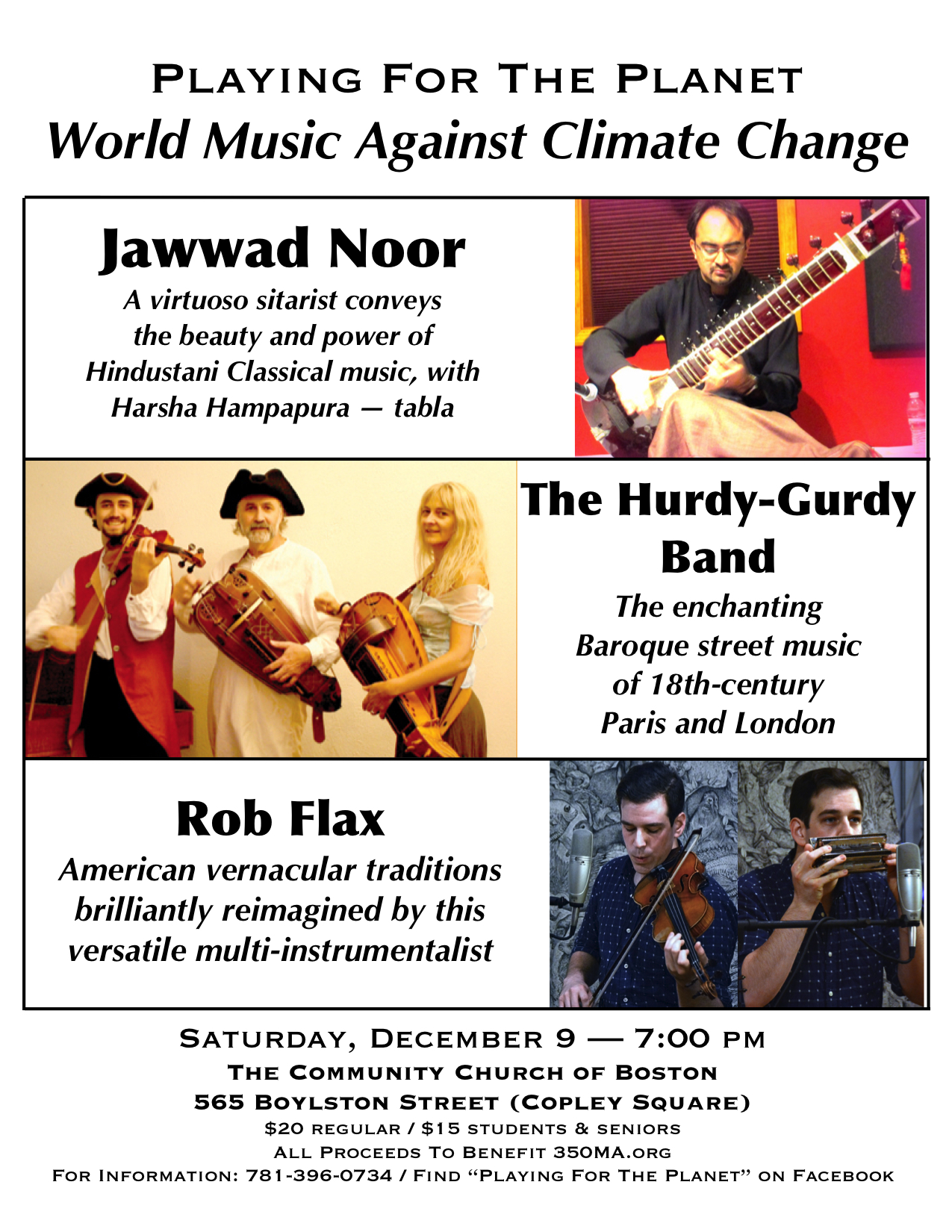
“Playing For The Planet: World Music Against Climate Change” is the sixteenth concert in an ongoing series of cross-cultural events produced by Boston-area musician and environmental activist Warren Senders. These concerts were conceived as a way for creative musicians to contribute to the urgent struggle against global warming. Their beneficiary, 350MA.org, is focused on building global consensus on reduction of atmospheric CO2 levels — action which climatologists agree is necessary to avoid catastrophic outcomes.
About The Artists
Jawwad Noor — Sitar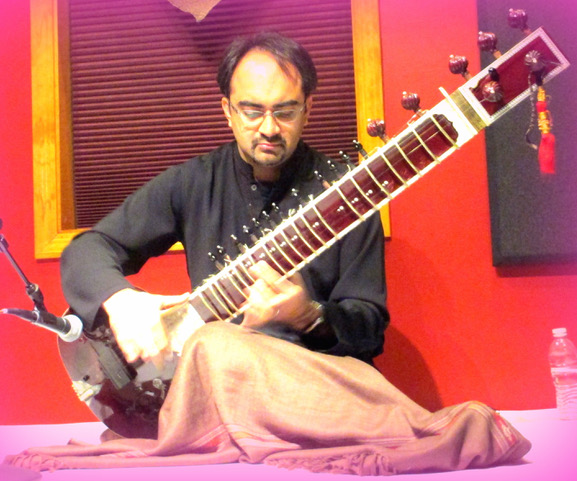
Harsha Hampapura — Tabla
Jawwad Noor was initiated into sitar by Ustad Alam Khan of Lahore.
He went on to become a disciple of the world’s leading sitarist, Ustad Shahid Parvez Khan, under whose exacting standards he extensively studies the melodic and rhythmic fou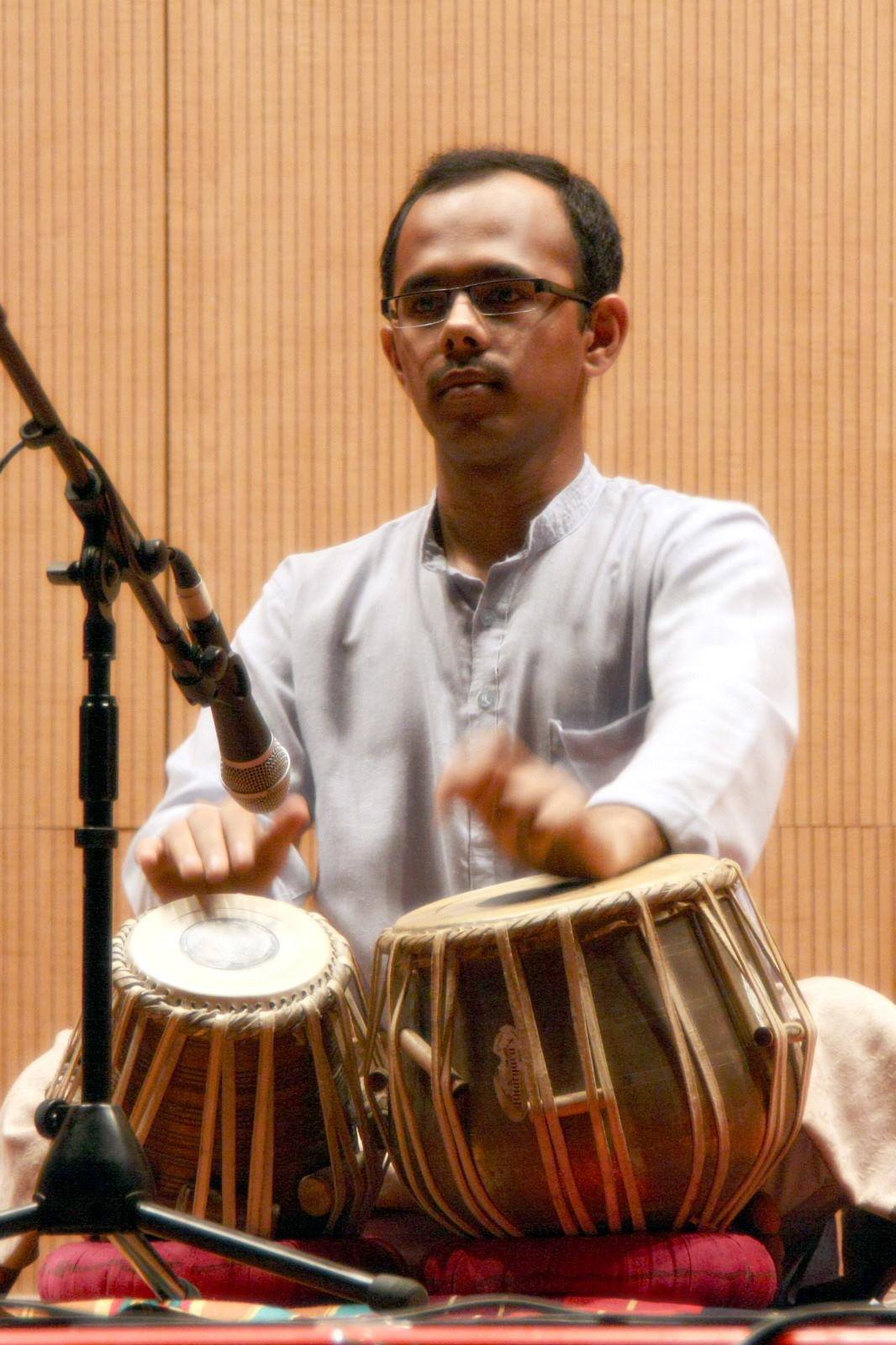 ndations of the music and trains to play the sitar in the vocal idiom.
Jawwad has been bringing his impassioned performances to audiences regularly and widely for many years. He is a senior instructor of the Shahid Parvez Khan Academy, and teaches at the LearnQuest Academy of Music. On December 10, he will be accompanied on tabla by Harsha Hampapura, who first studied with Shri Ram Hegde Keremane, and has been learning the Punjab style from Shri Anup Joshi for the past 6 years.
Rob Flax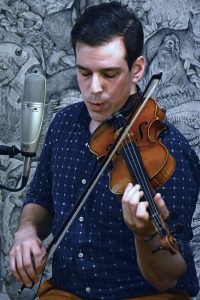
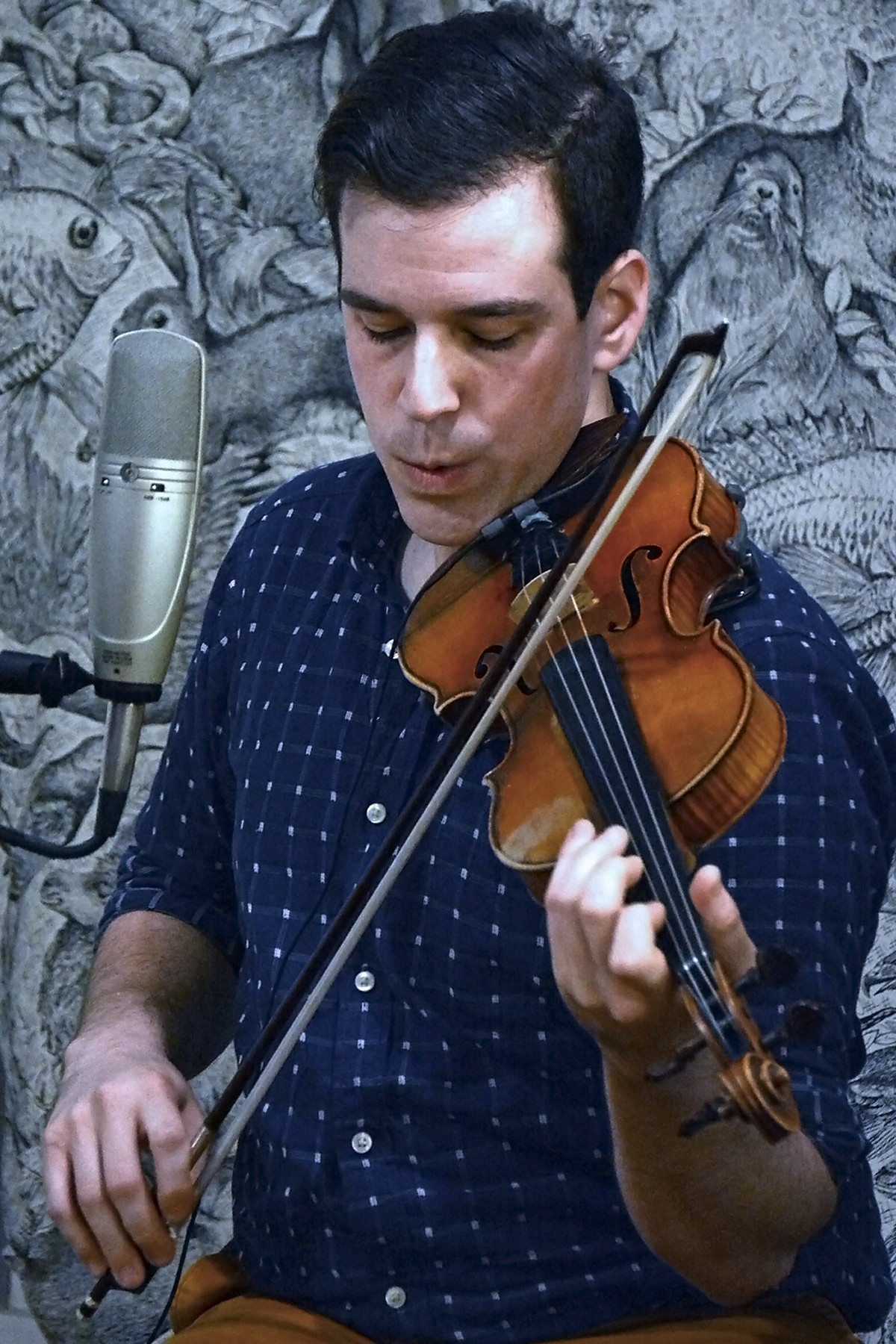
Multi-instrumentalist Rob Flax describes his music in a concise way: “I play things with strings, I hit stuff, and I sing.” Behind this simple tag line lies a rich depth of genre-bending, from classical and jazz violin to bluegrass fiddle, to blues and rock influences, and beyond. In his “One Man Band” shows, Rob uses a looper pedal and other effects to transform his violin into an entire symphony of sounds.
“Rob’s unique blend of ancient and modern brings the violin into the 21st century with a dazzling array of digital technology seamlessly mated to the traditional world of wood, gut, and bone.” —Stuart Rosenberg, WMFT
The Hurdy-Gurdy Band
The Hurdy-Gurdy is a mechanical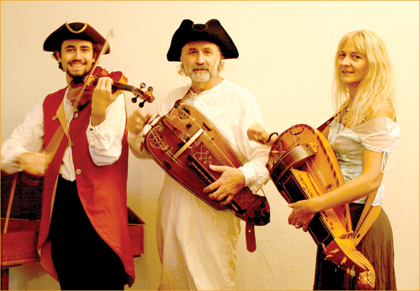 violin played all over Europe since the Middle Ages. It combines drones, melody and percussive rhythms to cast a powerful spell on listeners.
The Hurdy-Gurdy Band was formed in 1979 by Donald Heller and Anicét Mikolai. Since then, they have performed throughout Europe, Canada and the United States.
Inspired by the traditions of the itinerant (and sometimes pitifully poor) Hurdy-Gurdy players heard in the streets of 18th Century Paris and London, the Hurdy-Gurdy Band breathes new life into an all but lost art.
On December 9 they will be joined by their son Julien Heller, on violin.
ABOUT 350.org and 350MA.org
Co-founded by environmentalist and author Bill McKibben, 350.org is the hub of a worldwide network of over two hundred environmental organizations, all with a common target: persuading the world’s countries to unite in an effort to reduce global levels of atmospheric carbon dioxide to 350 parts per million or less. Climatologist Dr. James Hansen says, “If humanity wishes to preserve a planet similar to that on which civilization developed and to which life on Earth is adapted, paleoclimate evidence and ongoing climate change suggest that CO2 will need to be reduced from its current 400 ppm to at most 350 ppm.” (Dr. Hansen headed the NASA Institute for Space Studies in New York City, and is best known for his testimony on climate change to congressional committees in the 1980s that helped raise broad awareness of the global warming issue.) Activists involved in the 350 movement include Rajendra Pachauri (Chairman, Intergovernmental Panel on Climate Change), Vandana Shiva (world-renowned environmental leader and thinker), Archbishop Desmond Tutu (1984 winner of the Nobel Peace Prize and a global activist on issues pertaining to democracy, freedom and human rights), Van Jones, Bianca Jagger, Barbara Kingsolver and many more.
350MA.org is the Massachusetts Chapter of this worldwide advocacy group, and the hub for the Better Future Project.
The Community Church of Boston is a free community united for the study and practice of universal religion, seeking to apply ethical ideals to individual life and the democratic and cooperative principle to all forms of social and economic life. We invite you to read on to discover more about us, join us one Sunday for a thought-provoking and joyful time, or contact the church to find out more about our community: info@communitychurchofboston.org
environment Indian music music vocalists: benefit concert
by Warren
leave a comment
Meta
SiteMeter
Brighter Planet
Playing For The Planet: World Music Against Climate Change — June 10, 2017

PLEASE NOTE: CCNOW IS EXPERIENCING PROBLEMS AND WE ARE WORKING ON IT. PLEASE USE THE EVENTBRITE LINK TO PURCHASE TICKETS BY PAYPAL INSTEAD. OUR APOLOGIES!!!
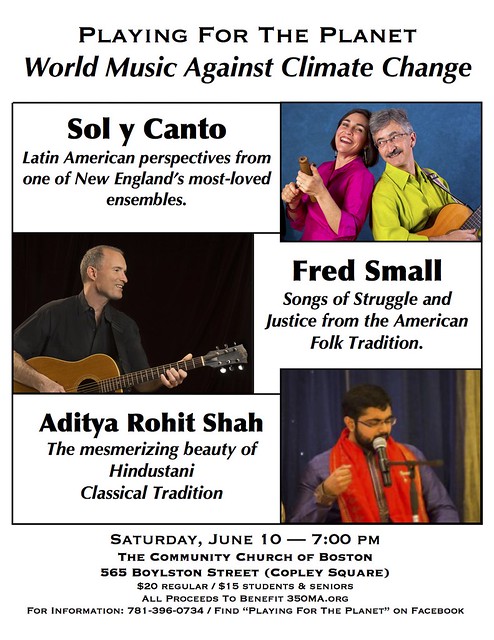
On Saturday, June 10, the fifteenth “Playing For The Planet” benefit concert will showcase master musicians from three different musical traditions in a rare and joyful pan-cultural evening, with all proceeds going to benefit the environmental advocacy group 350MA.org. The performers include the joyful Latin American perspectives of Sol y Canto, the enthralling North Indian vocal music of Aditya Rohit Shah, and the Rev. Fred Small’s compelling songs of struggle and justice. The music begins at 7:00 pm, at The Community Church Of Boston, 565 Boylston Street (Copley Square), Boston. Admission is $20; $15 students & seniors.
“…Senders possesses a gift
for assembling fascinating programs.”
— Andrew Gilbert, The Boston Globe —
“Playing For The Planet: World Music Against Climate Change” is the fifteenth concert in an ongoing series of cross-cultural events produced by Boston-area musician and environmental activist Warren Senders. These concerts were conceived as a way for creative musicians to contribute to the urgent struggle against global warming. Their choice of beneficiary, 350MA.org, is focused on building global consensus on reduction of atmospheric CO2 levels — action which climatologists agree is necessary to avoid catastrophic outcomes.
Because the climate problem recognizes no national boundaries, the artists represent musical styles from three different parts of the globe, and share key musical values: listening, honesty, creativity, and respect. And, of course, they are all committed to raising awareness of the potentially devastating effects of global warming. It’ll be an incredible evening of powerful music — from some of the finest musicians in New England and the world.
“…Pleasant surprises and stimulation of the aesthetic synapses…an open-ended, floating, world music festival.”
— Steve Elman, ArtsFuse —
Purchase tickets online from CCNOW:
Regular admission: $20
Student/Senior Admission: $15
Advance orders will be accepted until 3 pm on June 10.
If you prefer to use PayPal, please use the link below:
About The Artists
Sol y Canto
Puerto Rican/Argentine singer and bongo player Rosi Amador and New Mexican guitarist and composer Brian Amador have been lucky enough to spend more than two decades composing, arranging and performing music that moves people inside and out; songs that combine poetic lyrics, commitment to social change, and sabor, the “tastiness” of music that draws you into its story or makes you want to get up and dance.
Sol y Canto, their three-time Boston Music Award winning Latin roots ensemble, is the culmination of their musical vision. Featuring Rosi’s crystalline voice and Brian’s lush Spanish guitar, they’ve established a reputation for their quirky original compositions addressing life, love and social justice. Since 1994, Sol y Canto has brought audiences to their feet from the Kennedy Center, the White House, and Boston’s Symphony Hall, the California World Music Festival and Puerto Rico’s Museo de Arte to the Kimmel Center in Philadelphia.
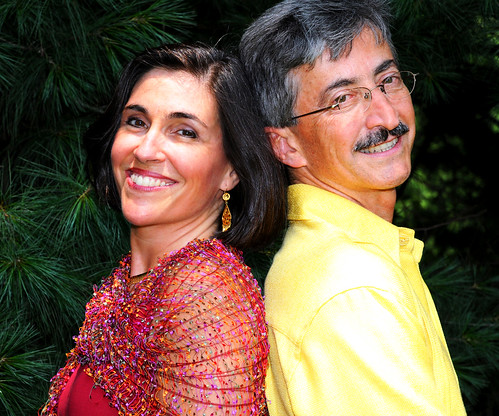
Sol y Canto is known for making their music accessible to Spanish- and non-Spanish speaking audiences of all ages. People en Español Magazine selected Rosi and Brian for its 2007 “Stars of the Year” issue, highlighting four inspiring Hispanics who have used their passion, conviction, creativity and self discovery to achieve success.
Brian Amador – Musical director, composer, arranger, acoustic guitar, voice
A Chicano/Gringo mongrel from Albuquerque, New Mexico, Brian was one of the founding members of Flor de Caña, arranging much of the band’s material and co-producing two recordings. He studied classical guitar, composition, and improvisation at New England Conservatory of Music in Boston, and flamenco guitar in Albuquerque and Madrid. For five years Brian was principal guitarist of the Ramón de los Reyes Spanish Dance Theatre. Brian’s guitar style is as mixed as his heritage, combining flamenco, classical, Cuban son, Latin American styles, and jazz.
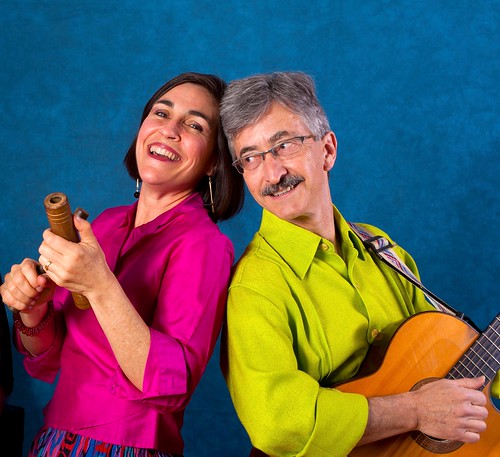
Of Argentine and Puerto Rican heritage, Rosi’s performer parents passed on to her their love of Latin American rhythms and musical styles. Her mother was a dancer, a singer and an actress. She appeared in the U.S. on Broadway, in Europe with Bob Hope, Jerry Lewis and Dean Martin among others, and in Mexico with comic actor “Cantinflas” (Mario Moreno). Her father began in radio in Buenos Aires and later became an actor, touring all over Latin America. With ten years of training as a classical singer, Rosi has been deeply influenced by popular Latin music, jazz, North American folk, blues and contemporary African vocal styles.
Find Sol y Canto online!
Aditya Rohit Shah
Aditya Rohit Shah, 23, grew up in Pune, India, where he began his musical training under Shri Sanjay Kadam of the Gwalior Gharānā. Since 2007, he has trained in North Indian Classical Vocal Music under the guidance and blessings of Pandit Rattan Mohan Sharma and Pandit Radharman Kirtane, direct disciples of his Bade-Guruji Sangeet Martand Padmavibhushan Pandit Jasraj-ji.
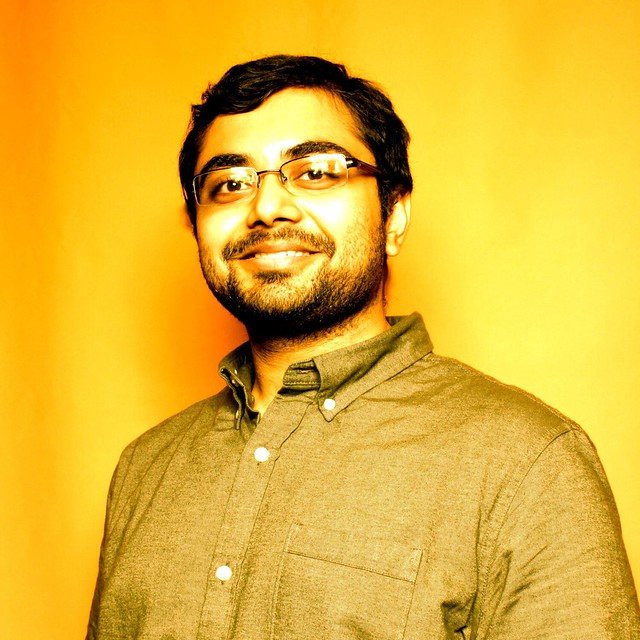
In 2012, Aditya was selected to perform a solo concert for Dr. A.P.J. Abdul Kalam, the former President of India. He won First Place in his age category in SwarGanga’s prestigious “Crescendo” National Competition (USA & Canada) in 2013. In 2013, he was deeply honored to receive the prestigious “Mewati Pradeept” award from the Pandit Jasraj Institute, which marked the commencement of his solo musical career. He is deeply thankful to have the heartfelt blessings of his Bade-Guruji. With his Gurus’ blessings, he has performed at many venues in the States, India, and the UK.
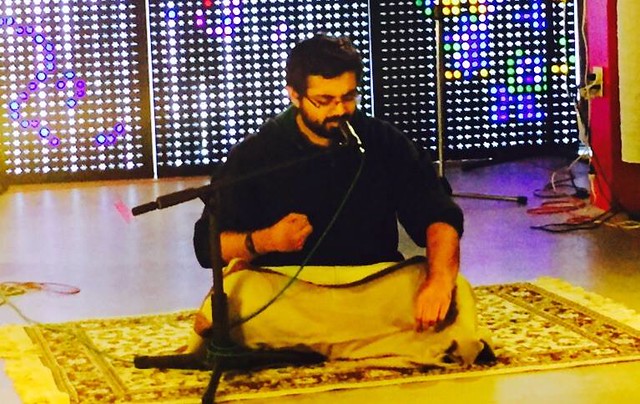
He graduated from Dartmouth College in June 2015, where he studied History and Economics. He is also currently working on several musical projects, including a debut classical album and an album of devotional Jain hymns. He recently released a music video of the Kabir Poem, “Jhini Jhini Chadariya.” An Inbound Sales Consultant at HubSpot, he is a faculty member at LearnQuest.
Find him at: facebook.com/swarpremi.”
Rev. Fred Small
Hailed by Pete Seeger as “one of America’s best songwriters,” Fred Small sings songs of conscience in the tradition of Pete Seeger, Tom Paxton, and Holly Near. Powerful, affecting, and inviting, Fred’s songs illuminate the goodness and courage of all kinds of people.
Pete Seeger, Peggy Seeger, Rosalie Sorrels, Steve Gillette, Judy Small (no relation), Roy Bailey, the Flirtations, and the Boston Gay Men’s Chorus are among the singers who have interpreted Fred’s songs to audiences around the world.
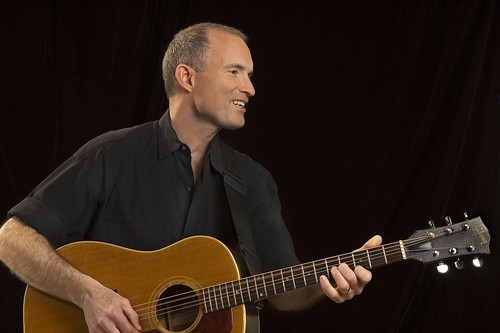
Fred’s song “The Heart of the Appaloosa” was elected to the All-Time Bluegrass Hit Parade by WAMU Radio in Washington, DC In 1992, Heart Strings, the nationally touring AIDS-benefit musical, chose Fred’s empowering lullaby “Everything Possible” as its grand finale. In 2000, the National Organization of Men against Sexism (NOMAS) honored Fred for his contributions to gender justice.
Fred has released eight albums: Live at First Parish (Aquifer, 2009), Only Love (Aquifer, 2001), Everything Possible (Flying Fish, 1993), Jaguar (Flying Fish, 1991), I Will Stand Fast (Flying Fish, 1988), No Limit (Rounder, 1985), The Heart of the Appaloosa, 1983) (all Flying Fish and Rounder titles available at this link), and Love’s Gonna Carry Us (Aquifer, 1981). Fred’s two songbooks, Promises Worth Keeping (1994) and Breaking from the Line (1986) are published by Yellow Moon Press.
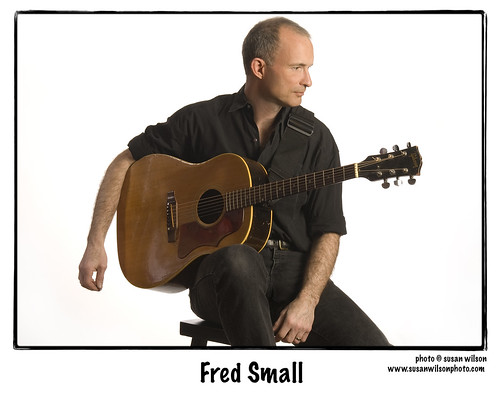
Fred Small was born November 6, 1952, in Plainfield, NJ. Grandnephew of Thomas Hart Benton, the American regionalist painter (and outstanding harmonica player), Fred was playing guitar and singing folk songs by age seven. After graduating Phi Beta Kappa from Yale, Fred earned a law degree and a masters in natural resources policy at the University of Michigan. He wrote his first song in 1974 on the morning of his first law school examination. In 1980 Fred left his position as staff attorney at the Conservation Law Foundation to pursue his career in music full time.
In 1999, Fred was awarded his Master of Divinity degree from Harvard Divinity School. After serving First Church Unitarian in Littleton, MA, and First Parish in Cambridge, MA, in 2015 Fred left parish ministry to devote his energies to climate activism, especially among people of faith. He is now Minister for Climate Justice at Arlington Street Church, Boston.
Fred has performed throughout the United States as well as in Japan, Australia, England, and Canada. He has appeared at the Philadelphia, Vancouver, Winnipeg, and Kerrville Folk Festivals, Lunenburg (NS) Folk Harbour Festival, Sidmouth (UK) Folk Arts Festival, National Folk Festival of Australia, Great Hudson River Revival, Great River Traditional Music & Crafts Festival (LaCrosse, WI), Woody Guthrie Tribute (Tulsa, OK), Bread and Roses Labor Heritage Festival (Lawrence, MA), and the Musicians United for Safe Energy (MUSE) rally in New York City.
ABOUT 350.org and 350MA.org
Co-founded by environmentalist and author Bill McKibben, 350.org is the hub of a worldwide network of over two hundred environmental organizations, all with a common target: persuading the world’s countries to unite in an effort to reduce global levels of atmospheric carbon dioxide to 350 parts per million or less. Climatologist Dr. James Hansen says, “If humanity wishes to preserve a planet similar to that on which civilization developed and to which life on Earth is adapted, paleoclimate evidence and ongoing climate change suggest that CO2 will need to be reduced from its current 400 ppm to at most 350 ppm.” (Dr. Hansen headed the NASA Institute for Space Studies in New York City, and is best known for his testimony on climate change to congressional committees in the 1980s that helped raise broad awareness of the global warming issue.) Activists involved in the 350 movement include Rajendra Pachauri (Chairman, Intergovernmental Panel on Climate Change), Vandana Shiva (world-renowned environmental leader and thinker), Archbishop Desmond Tutu (1984 winner of the Nobel Peace Prize and a global activist on issues pertaining to democracy, freedom and human rights), Van Jones, Bianca Jagger, Barbara Kingsolver and many more.
350MA.org is the Massachusetts Chapter of this worldwide advocacy group, and the hub for the Better Future Project.
====================================
The Community Church of Boston is a free community united for the study and practice of universal religion, seeking to apply ethical ideals to individual life and the democratic and cooperative principle to all forms of social and economic life. We invite you to read on to discover more about us, join us one Sunday for a thought-provoking and joyful time, or contact the church to find out more about our community: info@communitychurchofboston.org
====================================
atheism environment Indian music Jazz music Personal vocalists Warren's music
by Warren
leave a comment
Meta
SiteMeter
Brighter Planet
“Singing The Long Now” — Concert Videos
The videos and sound recordings of the “Singing The Long Now” concert are now uploaded!
It was an extraordinary experience to prepare this material for performance, and to review it after the fact. Tufts University did a fine job with both audio and video, and I really enjoyed getting the pieces formatted and organized for this page. Please let me know your thoughts.
Needless to say, my most profound gratitude and love goes to the musicians:
Mimi Rabson — Violin, Voice
Helen Sherrah-Davies — Violin, Voice
Junko Fujiwara — ‘Cello, Voice
I’m presenting them all in order on this page, with some links to supplementary material as needed.
1. Hymn theme: “The Great Ocean Of Truth” / Raga Puriya Dhanashri: Alap, Khyal in 7 beats, Tarana in 12 beats.
Raga Puriya Dhanashri is usually meant for performance in the early evening. This suite of traditional Hindustani compositions is arranged for voice and string trio; the instrumental ensemble plays a redistribution of the standard accompaniment parts in support of vocal improvisation. The introductory alap is sung on open vowels and vocables, the medium-tempo khyal has a text in Braj (an archaic Hindi dialect) describing a scene from the life of Krishna, and the fast tarana is set entirely to non-lexical syllables.
2. A Hard Rain’s A-gonna Fall
Bob Dylan’s jeremiad is recomposed in Raga Mishra Dhani, the new melodic setting evoking both the apocalyptic surrealism of “Old Weird America” and the convoluted, polysemic language of the Urdu ghazal. The strings’ churning undercurrent hews to the basic 6-beat structure of the Hindustani Dadra taal, but can just as easily be heard as a group of rowdy country fiddlers.
3. “It’s Taken Me My Whole Life…”
This composition is built around the ritualized use of silence at different tempo levels. Every performer has a variety of pre-established melodic/rhythmic patterns, punctuated by extemporized “omissions” — this means that when (and how often) to be silent becomes the main focus of creative choice. Even segments of virtuoso free improvisation are built around the idea that the notes unplayed and unheard are the sweetest, the most expressive, the most crucial.
(Note: complete copies of the score and individual parts will be uploaded and posted within the next fortnight.)
4. Pete Seeger’s melodic setting of Malvina Reynolds’ lyrics (reflecting the words of the first astronauts to view our planet from space) is given a free rendering, with the strings providing a colotomic structure, timbrally aligned with the beautiful music of Sundanese tradition.
“From way up here, the Earth looks very small,
It’s just a little ball, of rock and sea and sand,
No bigger than my hand.
From way up here, the Earth looks very small,
They shouldn’t fight at all, down there,
Upon that little sphere.
Their time is short, a life is just a day,
You’d think they’d find a way,
You’d think they’d get along, and fill their sunlit days with song.
From way up here, the Earth is very small,
It’s just a little ball, so small,
So beautiful and dear.
Their time is short, a life is just a day,
Must be some better way,
To use the time that runs, among the distant suns.
From way up here.”
5. Man With Sign — For Speaking/Singing Voice and String Trio
A reading from my ongoing intersectional activism/performance project, now in its seventy-fourth week of rush hour mornings at Medford’s Roosevelt Circle.
6. “This Is A Composition Which Concerns Itself With Timescale”
Like Paris’ Centre Pompidou, this composition for intoning voices and instruments wears its infrastructure on the outside. To say anything more in these notes would be redundant, except to note that the complete texts of the spoken parts can be found here.
7. The Spider’s Web
E.B. White’s words, Pete Seeger’s melody — my arrangement of this love song is a kind of “folk minimalism,” using asynchronous repetition of simple melodic phrases to create background textures that allow the melodic line and its meaning to unfold.
“The spider dropping down from twig, unfolds a plan of her devising:
A thin, premeditated rig, to use in rising.
And on this journey down through space, all cool descent and loyal-hearted,
She builds a ladder to the place, from where she started.
Thus I, gone forth as spiders do, in spider’s web a truth discerning,
Attach one silken strand to you, for my returning.”
8. The great jazz innovator Ornette Coleman once remarked, “I wish people would play my tunes with different changes every time, so there would be all the more variety in the performance.” Whenever we approach Ornette’s music, we try to keep this in mind.
“What reason could I give to live?
Only that I love you.
How many times must I die for love?
Only when I’m without you.
Where will the world be, if not in the sky when I die?
What reason could I give to live?
Only that I love you.”
9. Ancient Light / Ab Hone Lagyo
A meditation on time, trees, and light — followed by a thumri composition in the morning raga Kalingda. Set to the slow 16-beat chachar tala, this song in Braj extols the beauty of the new morning light, the songs of birds, the effulgence of opening blossoms — a tender, optimistic meditation on possibility and the inevitability of rebirth.
10. The title of this piece references one famous quote from Isaac Newton, and the text is another equally well-known remark from the great scientist (here altered slightly in the interest of gender equity). The words are set to three different eleven-beat structures in medium, fast, and slow tempi.
“I don’t know what I may seem to the world, but as to myself I seem like a child playing on the seashore / diverting myself, now and then finding a smoother pebble or a prettier shell / while the great ocean of truth lay all undiscovered before me.”
Education music Personal Warren's music: sources temporacy temporal literacy Warren's music
by Warren
leave a comment
Meta
SiteMeter
Brighter Planet
Texts for “This Is A Composition Which Concerns Itself With Timescale”
These are the texts used in the February 5 performance of “This Is A Composition Which Concerns Itself With Timescale.”
Details of the performance structure will be posted in the next couple of weeks as I get materials uploaded.
LUCA, an acronym for the last universal common ancestor, probably dates to around 3.8 billion years ago. At that time, LUCA was bobbing around on ocean waves with neither worries nor neighbors. Our human ancestors differentiated from other living beings about one billion years ago. About four hundred million years ago, the earliest froglike beings developed joints on their pectoral and pelvic fins and slithered out of the sea onto land.
About 1.8 million years ago, our African ancestors moved North into the Caucasus and slowly spread out across what is now Europe and Asia. Roughly forty thousand years ago, people crossed what we call the Bering Sea into the great landmass of the Northern hemisphere. Almost one thousand years ago, Europeans built small boats and sailed across unknown oceans toward an unknown land.
Mary Pipher — The Green Boat pp 188-189
The destiny of our species is shaped by the imperatives of survival on six distinct time scales. To survive means to compete successfully on all six time scales. But the unit of survival is different at each of the six time scales. On a time scale of years, the unit is the individual. On a time scale of decades, the unit is the family. On a time scale of centuries, the unit is the tribe or nation. On a time scale of millennia, the unit is the culture. On a time scale of tens of millennia, the unit is the species. On a time scale of eons, the unit is the whole web of life on our planet. Every human being is the product of adaptation to the demands of all six time scales. That is why conflicting loyalties are deep in our nature. In order to survive, we have needed to be loyal to ourselves, to our families, to our tribes, to our cultures, to our species, to our planet. If our psychological impulses are complicated, it is because they were shaped by complicated and conflicting demands.
The earliest known trade routes in regular use crisscrossed eastern Europe about 30,000 years ago, distributing prefashioned blanks of flint from mines in Poland and Czechoslovakia over a wide area. It was in eastern Europe, too, that the oldest ceramic objects yet discovered were made, [including] models of animals and…a ceramic “Venus” — a stylized figurine of a woman…this European site, shared by more than a hundred people, affords the eariest evidence of a quantum jump in the sizes of human groups and the advent of the first communities larger than family bands.
Nigel Calder — Timescale, p. 159
A huge colony of the sea grass Posidonia oceanica in the Mediterranean Sea could be up to one hundred thousand years old.
(wikipedia)
An attosecond is 1 times 10- to-the-minus-eighteenth — one quintillionth — of a second.
It is the time it takes for light to travel the length of two hydrogen atoms.
An attosecond is to a second what a second is to about 32 billion years.
(wikipedia)
In hillside caves of southwestern Germany, archaeologists have uncovered the beginnings of music and art by early modern humans. .. New evidence shows that these oldest known musical instruments in the world, flutes made of bird bone and mammoth ivory, are even older than first thought.
Animal bones found with the flutes were 42 to 43,000 years old, [dating them to] around the time the first anatomically modern humans spread into Central Europe… along the Danube River valley.
If we imagine ourselves living in New England in the 1700s, and we then imagine ourselves looking from that vantage point into the future, does the rural landscape as we now know it seem unattractive because it no longer looks like it did when Queen Anne ruled the colonies? Would a longer step back to the 1500s make us protest the Spanish introduction of culture-changing horses to this continent? And would a step even farther back in time make us mourn the arrival of the first Stone Age humans who would slaughter the American mammoths and mastodons and thus leave our landscapes unnaturally silent — but much safer to walk in?
Curt Stager — Deep Future
Two-hundred and fifty million year-old bacteria, Bacillus permians, were revived from stasis after being found in sodium chloride crystals in a cavern in New Mexico.
Having survived for 250 million years, it is the oldest living thing ever recorded.
(wikipedia)
A visit to a Pleistocene cave in southern France reveals the past in subtle ways. Paintings on the cave walls and ceiling show a pack of wild horses galloping along a ledge, while vivid antlered reindeer leap toward the viewer from nearby walls. Bison scratched into stone show fine-line features of nostrils, eyes, and hair. Big- bellied horses lope toward us on short legs.
Some prehistoric master saw the essence of these animals embedded in the chance curves of the cave, [and] called them forth to the eye, using negative space in ways we do not witness again until the work of the sixteenth century.
These signals across tens of millennia carry a heady sense of graceful intelligence. We know well enough what animals lived then, but only in such paintings can we delve into the cerebral wealth of our ancestors…These paintings… are the best sort of deep time messages, conveying wordless mastery and penetrating sensitivity across myriad millennia and staggeringly different cultures.
Gregory Benford — Deep Time, p. 202
The galactic year, also known as a cosmic year, is the duration of time required for the Solar System to orbit once around the center of the Milky Way Galaxy. Estimates of the length of one orbit range from 225 to 250 million terrestrial years.
(wikipedia)
Biologists track the extinction of whole genera, and in the random progressions of evolution feel the pace of change that looks beyond the level of mere species such as ours. Darwinism invokes cumulative changes that can act quickly on insects, while mammals take millions of decades to alter. Our own evolution has tuned our sense of probabilities to work within a narrow lifetime, blinding us to the slow sway of long biological time.
Gregory Benford — “Deep Time”
One day in the life of Brahma is called a Kalpa, and lasts 4.32 billion years. Every Kalpa, Brahma creates 14 Manus, who in turn manifest and regulate this world.
Each Manu perishes at the end of his life, and Brahma creates the next. The cycle continues until all fourteen Manus, and the Universe, perish at the end of Bramha’s day. Then Brahma sleeps for a period of 4.32 billion years. The next ‘morning’, Brahma creates fourteen Manus in sequence, just as he has done on the previous ‘day’.
This cycle continues for 100 ‘divine years’ at the end of which Brahma perishes and is regenerated. Brahma’s entire life equals 311 trillion, 40 billion years.
Once Brahma dies there is an equal period of unmanifestation for 311 trillion, 40 billion years, until the next Brahma is created.
(wikipedia)
Jiahu was a Neolithic settlement in the central plain of ancient China, near the Yellow River. Settled around 7000 BC, the site was flooded and abandoned around 5700 BC.
Among the discoveries at Jiahu were playable flutes made from the wing bones of the Red- Crowned crane, tuned to the pentatonic scale.
(source)
Consider…a coniferous forest. The hierarchy in scale of pine needle, tree crown, patch, stand, whole forest, and biome is also a time hierarchy. The needle changes within a year, the tree crown over several years, the patch over many decades, the stand over a couple of centuries, the forest over a thousand years, and the biome over ten thousand years. The range of what the needle may do is constrained by the tree crown, which is constrained by the patch and stand, which are controlled by the forest, which is controlled by the biome.
Stewart Brand — Clock Of The Long Now, p. 34
We are ever restless, we hominids. It is difficult to see what would finally still our ambitions — neither the stars, nor our individual deaths, would ultimately form a lasting barrier. The impulse to push further, to live longer, to hourney farther — and to leave messages for those who follow us, when we inevitably falter and fall — these will perhaps be our most enduring features.
Still we know that all our gestures at immortality — as individuals or even as a lordly species — shall at best persist for centuries or, with luck, a few millennia. But ultimately they shall fail.
Intelligence may even last to see the guttering out of the last smoldering red suns, many tens of billions of years hence. It may find a way to duddle closer to the dwindling sources of warmth in a iuniverse that now seems to be ever-expanding, and cooling as it goes. Whether intelligence can persist against this final challenge, fighting the ebb tide of creeping entropy, we do not know.
But humans will have vanished long before such a distant waning. That is our tragedy. Knowing this, still we try, in our long twilight struggles against the fall of night. That is our peculiar glory.
Gregory Benford — “Deep Time”