India Indian music music vocalists: 78 rpm discs
by Warren

1 comment
Meta
SiteMeter
Brighter Planet

78 rpm Records of Indian Music: Bangri Geets by Sardar Bai
This disc was part of the collection of 78s I acquired in Udaipur in 2000. These songs would appear to be in the Bangri language, which is also known as Haryanvi.
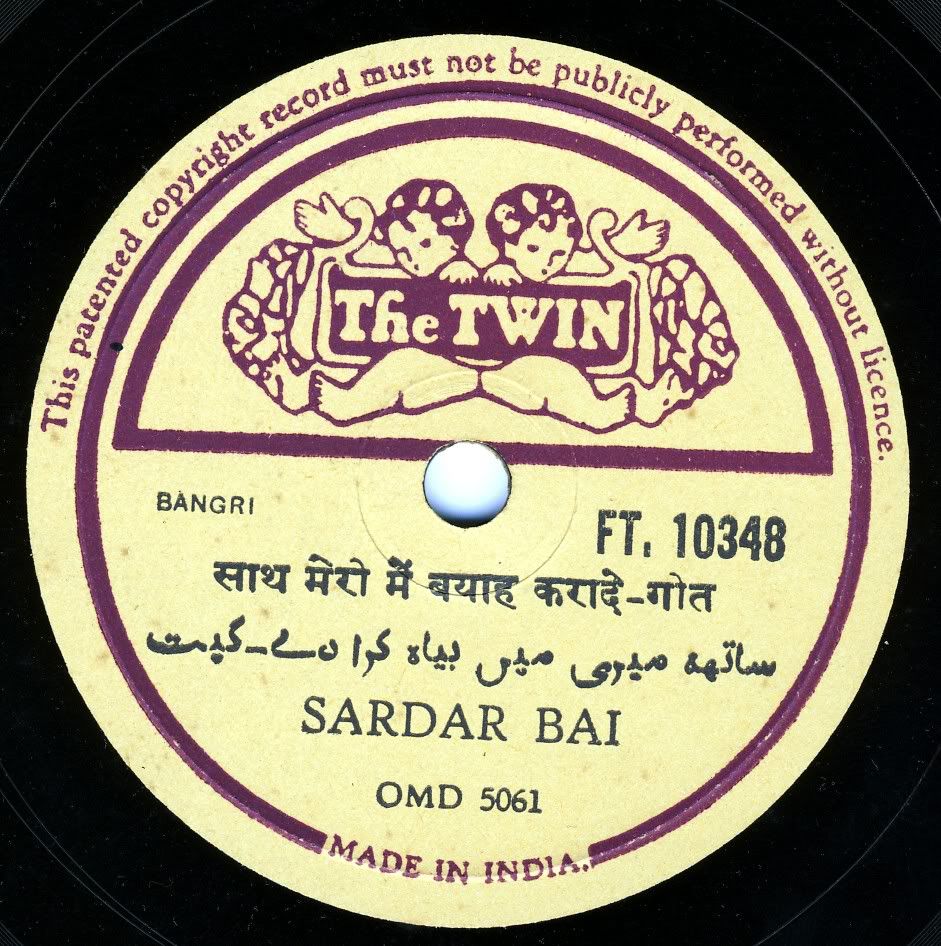
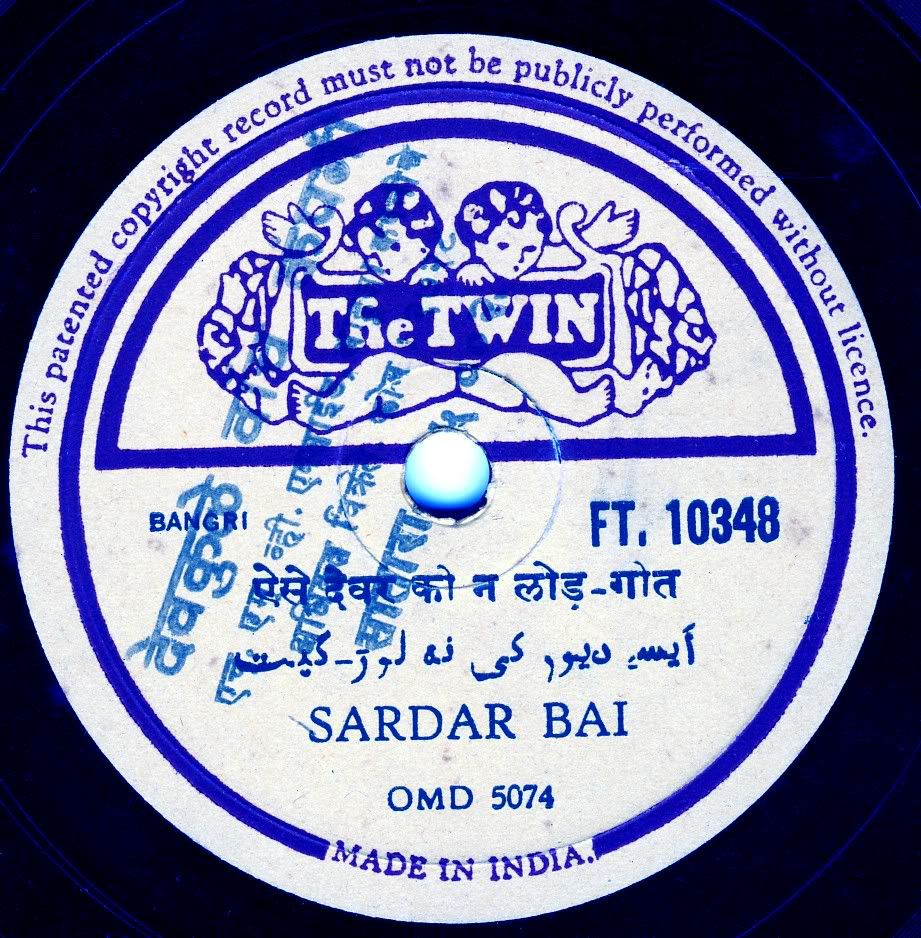
It is possible that this music is specific to the Bangri people, about whom little information is available beyond this:
The 5.7 million Bangri are located mainly in the states of Haryana, Karnataka, Himachal Pradesh, Uttar Pradesh, Punjab, and Delhi. Their language, Bangaru, is a member of the Indo-Aryan language family. Little is known about their specific lifestyle and culture.
Link
Irritatingly for my atheistic self, the site is that of PrayWay, a “global prayer community” that lists the Bangri among the world’s “unreached” peoples:
* People name: Bangri
* Country: India
* Their language: Bangaru
* Population:
(1990) 5,251,200
(1995) 5,776,500
(2000) 6,309,100
* Largest religion:
Hindu 98.4%
* Christians: 1.6%
* Church members: 92,425
* Scriptures in their own language: None
* Jesus Film in their own language: None
* Christian broadcasts in their own language: None
* Mission agencies working among this people: 2
* Persons who have heard the Gospel: 1,421,000 (25%)
Those evangelized by local Christians: 439,000 (8%)
Those evangelized from the outside: 982,000 (17%)
* Persons who have never heard the Gospel: 4,355,500 (75%)
Fortunately for us, there’s no need to convert these folks; let’s just listen to these two songs.
No information is available about Sardar Bai; there have been various well-known singers with that name in India’s recent history. I’m betting this isn’t one of them.
Saath Meri Men Bayaah Karaade
Aise Devar Ko Na Lod
environment: corporate irresponsibility deforestation forests scientific consensus
by Warren
leave a comment
Meta
SiteMeter
Brighter Planet
Year 2, Month 8, Day 2: O Tannenbaum, O Tannenbaum
More on the Forests study, this time from the Christian Science Monitor for July 17:
Want to save the planet? Plant a tree.
Or maybe a lot of them. Or maybe don’t cut down so many.
These are the implications of a new study, which found that the world’s forests play an unexpectedly large role in climate change, vacuuming up the greenhouse gas carbon dioxide (CO2) and storing the carbon in wood, according to research published online Thursday by the journal Science.
That, in turn, helps regulate CO2 concentrations in the atmosphere – and keeps the planet from overheating.
Kind of a clunky letter, but I’m having kind of a clunky day, so it fits. Sent Sunday, July 17, as the expected heat wave starts moving into position.
Extreme weather events are coming faster and faster, harder and harder, all over the planet. It looks like our carbon dioxide chickens are coming home to roost, as emissions from the last century’s fossil fuel consumption accumulate in the atmosphere. A runaway greenhouse effect may not yet be totally inevitable, but it’s definitely on the horizon unless all of the world’s nations take serious and concerted action against climate chaos. Our history of slash-and-burn deforestation has devastated millions of acres of carbon sink — in the name of disposable paper products. Humanity’s survival cannot be assumed in an economic system that assigns value to destroying the ecosystems of which we are a part. The discovery that our planet’s forests absorb more CO2 than was previously suspected is good news, but it comes with an important caveat: we must ensure that forest lands are preserved and expanded over the coming years.
Warren Senders
India Indian music music vocalists: 78 rpm discs weirdness
by Warren
1 comment
Meta
SiteMeter
Brighter Planet
78 rpm Records of Indian Music: Hindustani Comic Song by Mr. Muradaly & Others
I have no information on “Mr. Muradaly and others.” But as I was pawing through a big stack of 78s in the middle of Chor Bazaar years ago, my eye was caught by this record.
How could I resist a “Hindustani Comic Song”?
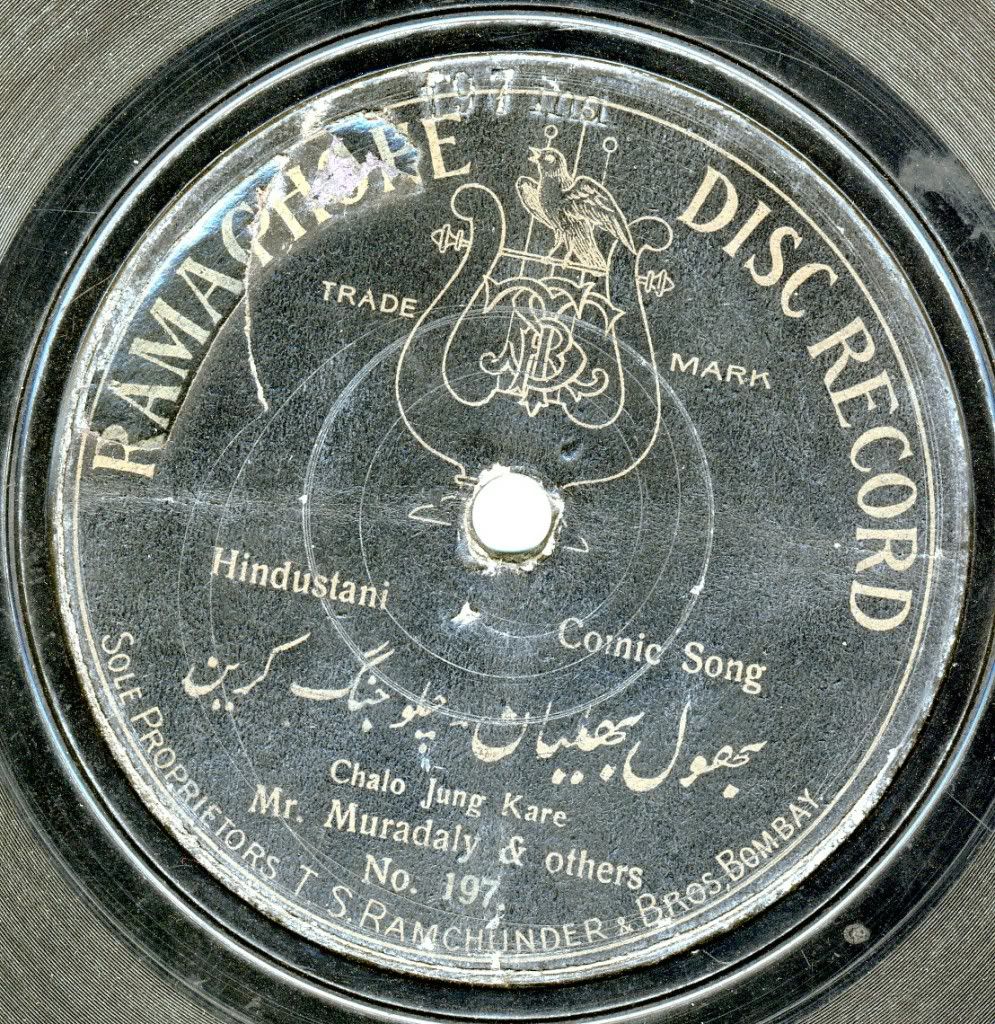
“Chalo Jung Kare” translates roughly as, “Come! Let’s go to war,” and indeed the military is clearly being lampooned, what with bugle calls and all. Do I detect some dialect humor?
Enjoy.
environment: Damoclean threat glaciers mountains
by Warren
leave a comment
Meta
SiteMeter
Brighter Planet
Year 2, Month 8, Day 1: From The Roof Of The World…
One of the world’s most experienced Everest hands, Apa Sherpa, has firsthand testimony about the effects of climate change, reports the July 16th edition of The Hindu:
It was in 1985 that Apa Sherpa, who scaled Mount Everest for the 21st time in May 2011, came face to face with climate change. His entire village Thame was washed away in a massive glacial lake outburst flood (GLOF) of the Dig Tsho (Tsho-lake), in the western section of the Sagarmatha (Mt. Everest) National Park, Khumbu Himal, on August 4, 1985.
The veteran mountaineer, who dropped out of school at 12 to work as a porter for expeditions to support his family, told The Hindu that the lake burst at 2 a.m. and he had a narrow escape. Now his worry is another glacial lake in the Everest region, Imja, which is growing bigger. “Imja Khola is a threat to the entire region and I can’t say if it is as safe as is made out to be. We have to do something before it bursts.” Imja, located in the Khumbu region close to the Everest base camp, did not exist in photographs taken in the 1950s, but now has rapidly expanded to 1.012 sq km.
When The Force offers you a good analogy, take it. Sent July 16:
The Sherpa villagers below the burgeoning Imja lake in Mount Everest’s shadow have much to teach the rest of humanity. Of all the world’s peoples, these villagers have contributed not a single iota to the CO2 emissions that have built up in our atmosphere over the past century and now threaten to trigger a runaway greenhouse effect — yet they are the ones who daily look up at a growing lake poised over their heads.
All the Earth’s peoples now face the Sherpas’ Damoclean predicament. If humanity is to endure and prosper, it is time to get to work on controlling our carbon emissions, addressing the genuine threat of climate change. The world’s political and economic leaders appear to care more for profits than people, but it’s only through a global transition to renewable energy that they, and we, will survive the coming centuries of climate chaos.
Warren Senders
India Indian music music vocalists: 78 rpm discs genius
by Warren
8 comments
Meta
SiteMeter
Brighter Planet
78 rpm Records of Indian Music: Mr. Vishnupant Pagnis
Vishnupant Pagnis was one of the great voices of Marathi theater and early film. As these two recordings show, he was a hell of a singer.
Vishnupant Pagnis was an actor in Marathi theatre. At the age of 10 he joined Janubhau Nimkar`s Swadesh Hitachintak Natak Mandali in Kolhapur as an actor of female roles. His portrayals of Deval`s Sharada and Shakuntala in command performances for Shahu Maharaja won him popularity. He gained fame for creating the heroines of Warerkar`s first play Kunjavihari or `Wanderer in Gardens` in 1908 and Govindrao Tembe`s Shivraj Natak Mandali production in Hindi of Manishankar Trivedi`s Siddha-sansar or `Successful Life` in 1916.
The style of the celebrated Gujarati female impersonator, Jaishankar Sundari, is said to have influenced him. He appeared in Warerkar`s early silent film, Poona Raided in 1924. After his Sangitnatak career flagged, he taught music in a municipal school. A last-minute casting decision for the eponymous role in the successful movie Sant Tukaram or `Saint Tukaram` in 1936, he went on to play the lead in such“saint` films as Sant Tulsidas in 1939, Narsi Bhagat in 1940, and Mahatma Vidur in 1943, and grew famous as a Kirtan singer. He also headed a short-lived theatre company, Jagchhitradarshak Natak Mandali. Vishnupant Pagnis died in 1943.

He played the lead role in the film “biography” of the saint-poet Tukaram:
Sant Tukaram was also the subject of a biopic, title Sant Tukaram, made in 1936 by V. Damle and S. Fattelal of the Prabhat Film Company, starring Vishnupant Pagnis as the lead, and released on December 12, 1936 at the Central Cinema in Mumbai. The film was a big hit, and broke all previous records by running continuously for 57 weeks.[3] It also had won an award at the 5th Venice International Film Festival in 1937, and still remains a part of film appreciation courses.[4][5][6] It is preserved at the National Film Archive of India.[3]
Wiki

These two performances are from the early years of the twentieth century. The first is the celebrated patriotic song, Vande Mataram:
Vande Mataram (Devanagari: वन्दे मातरम्); Vande Mātaram “I bow to thee, Mother”) is a poem in the 1882 novel Anandamatha by Bankimchandra Chattopadhyay. It is written in a mixture of Bengali and Sanskrit.[1] It is a hymn to the goddess Durga, identified as the national personification of India. It came to be considered the “National Song of India”,[2] and it played a part in the Indian independence movement, first sung in a political context by Rabindranath Tagore at the 1896 session of the Indian National Congress.[3] In 1950, its first two verses were given the official status of “national song” of the Republic of India,[3] distinct from the national anthem of India Jana Gana Mana.
Wiki
Vande Mataram
And here is Patita Deenoduranan, a “Karnataki geet” in Sanskrit:
India Indian music music vocalists
by Warren
1 comment
Meta
SiteMeter
Brighter Planet
78 rpm Records of Indian Music: Mukul – “Haldi Ghaati”
Just the name Mukul.
This double-sided geet in Rajasthani sounds more like standard light-music performances, lacking the propulsive beat of traditional Rajasthani music. Damned if I know what “Haldi Ghaati” means.


Haldi Ghaati
environment: forests sustainability
by Warren
leave a comment
Meta
SiteMeter
Brighter Planet
Year 2, Month 7, Day 31: The Word for World
The July 15 Chicago Tribune reports on a new study that includes a teensy-weensy bit of good news about the ability of forests to absorb CO2:
SINGAPORE (Reuters) – The world’s forests can play an even greater role in fighting climate change than previously thought, scientists say in the most comprehensive study yet on how much carbon dioxide forests absorb from the air.
The study may also boost a U.N.-backed program that aims to create a global market in carbon credits from projects that protect tropical forests. If these forests are locking away more carbon than thought, such projects could become more valuable.
(snip)
The researchers found that in total, established forests and young regrowth forests in the tropics soaked up nearly 15 billion tonnes of CO2, or roughly half the emissions from industry, transport and other sources.
But the scientists calculated that deforestation emissions totaled 10.7 billion tonnes, underscoring that the more forests are preserved the more they can slow the pace of climate change.
A major surprise was the finding that young regrowth forests in the tropics were far better at soaking up carbon than thought, absorbing nearly 6 billion tonnes of CO2 — about the annual greenhouse gas emissions of the United States.
Maybe we should stop cutting down forests in order to make stuff to throw away? Just a thought. Sent July 15:
The societies that bear the brunt of tropical deforestation reap no benefits from their sacrifice; now it is apparent that the future of the planet as a whole may hinge on these woodlands’ continued good health. Sadly, in a non-localized global economy, those who profit from exploiting a commodity are hardly ever the ones to whom it originally belonged, and there is little motivation for careful long-term forest planning when a quick buck can be turned. How much paper do we throw away every day? How many lives, communities and ecosystems are grievously disrupted satisfying the developed West’s urgent need for disposable packaging? Our grandchildren deserve to inherit a green and bountiful world; the discovery that young-growth forests are hyperefficient absorbers of atmospheric CO2 underscores the importance of sustainable forestry everywhere on earth. Let’s take care of our forests — so that they may continue to take care of us.
Warren Senders
India Indian music music vocalists: 78 rpm discs
by Warren
2 comments
Meta
SiteMeter
Brighter Planet
78 rpm Records of Indian Music: Mr. Bhagoo of the New Alfred D. Company
Mr. Bhagoo, as the record label tells us, was one of the singers affiliated with the New Alfred D. Company, perhaps the most prominent theater group presenting Hindi and regional language drama at the beginning of the twentieth century.

His fine melismatic technique allows him to incorporate some tappa-ang taankari in this short performance.
Jake Chitme Chinta Buse
environment: National parks
by Warren
leave a comment
Meta
SiteMeter
Brighter Planet
Year 2, Month 7, Day 30: What Would Teddy Roosevelt Say?
The Indiana Post-Tribune runs an article on the same NRDC-sponsored report on the National Park System and its vulnerability to climatic transformations:
Beach erosion, sweltering summer temperatures and fierce storms are well-known occurrences at Indiana Dunes National Lakeshore. But according to a new report on Great Lakes national parks climate change, these events will intensify over the next 100 years, along with loss of plant species and economic activity at the park.
According to the report, “Great Lakes National Parks in Peril: The Threats of Climate Disruption,” released Wednesday by the Rocky Mountain Climate Organization and the Natural Resources Defense Council, temperatures at the national lakeshore are projected to rise 5 degrees by 2070, the equivalent of moving the climate of Raleigh, N.C., to Northwest Indiana. By 2100, average temperatures may rise an additional 3 degrees, bringing the climate of Gainesville, Fla., to the region.
Maybe some of the denialists will wake up. Sent July 14:
The national park system is one of our country’s greatest treasures. Since its inception, Theodore Roosevelt’s visionary initiative has offered countless visitors a chance to experience nature’s richness, complexity and beauty, laying a foundation for the contemporary environmental movement. Now the parks are playing another significant role in educating us all about the dangers of climate change. Living in cities and suburbs, sheltered from extremes of weather by heated, air-conditioned dwellings, we can easily dismiss the signals of the natural world — but the suffering of a cherished park space cannot be ignored. The RMCO/NRDC report confirms that climate change is a present-day crisis, not the responsibility of future generations. Our national parks are telling us loud and clear: we must transform our national energy economy rapidly to a focus on renewables if we are to mitigate the worst effects of a century’s worth of fossil fuel consumption.
Warren Senders
India Indian music music: 78 rpm discs genius
by Warren
1 comment
Meta
SiteMeter
Brighter Planet
78 rpm Records of Indian Music: Ali Ahmed Hussain – Shehnai
Ustad Ali Ahmed Hussain may not be as widely known as the great Shehnai master Bismillah Khan, but he’s an extraordinary player with a beautiful tone and a wonderfully lyrical approach:
Ustad Ali Ahmed Hussain Khan of Allahabad, the acknowledged premier shehnai specialist of Eastern India was born in Calcutta on March 21, 1939. His grand-father late Ustad Wazir Ali Khan was the first to demonstrate Indian classical music on shehnai at Buckingham Palace. His father late Ustad Ali Jan Khan and gurus late uncle Ustad Nazir Hussain Khan and late Ustad Imdad Hussain Khan of Benares were also renowned shehnai specialists. He presents shehnai in a soft, subtle and sweet tone enriched with melodious and mellifluous patterns. The purity of raags in his performances is a hallmark of his steadfastness to tradition. He has taught shehnai at Sangeet Research Academy, Calcutta since 1974.
He’s still playing, and he’s got his own website.
Enjoy these two short pieces of light classical music for their lilting melody and graceful improvisations
Kajri
Dadra