environment: minerals management service October 24 Action offshore drilling
by Warren

leave a comment
Meta
SiteMeter
Brighter Planet

Month 4, Day 23: Don’t Drill, Baby! Don’t Drill!
The program of exploratory drilling off the US coastline that was announced earlier by President Obama was the subject of a beautiful and poignant post by DK’s R.L.Miller. Go read it. She urges people to participate in this program:
The U.S. Department of Interior, Minerals Management Service, invites interested parties to participate in the 2012-2017 Five Year Outer Continental Shelf Oil and Gas Program Environmental Impact Statement (2012-2017 OCS Oil and Gas Programmatic EIS) scoping process. The scoping process is intended to involve all interested agencies (Federal, state, county, and local), public interest groups, Native American tribes, businesses, and members of the public. The public scoping period started with the publication of the Notice of Intent in the Federal Register.
The purpose of the public scoping process is to determine relevant issues that will influence the scope of the environmental analysis and the alternatives. Comments on the relationship between the Oil and Gas Program and the Alternative Energy Program are also welcome. Comments will be accepted at public scoping meetings, by mail, and electronically through a public comment form on this Web site.
In other words, go to the MMS site and object vociferously to the proposed Exploratory Drilling program. There’s a form there. As usual, I encourage you to use my words, paraphrasing as necessary. Object! Object! Object! The offshore drilling program is a piece of delusional chicanery that needs to be stopped.
Here’s what I wrote; I will submit this electronically and with a hard copy in the mail.
I write to express very strong objections to exploratory oil drilling anywhere off the U.S. coast, but especially on the Atlantic seaboard. There are numerous reasons why the proposed program should be shelved.
First: the issue of safety, for humans, oceanic ecosystems and coastlines.
Within the past month, there have been two oil disasters on the Atlantic seaboard, only one of which received any coverage in the media. An 18,000 gallon oil spill in the Gulf of Mexico was barely noticed, arguably because the news release was controlled by the Coast Guard, the state of Louisiana and the pipeline operator, Cypress Pipe Line Company. The April 6 spill covered about 120 square miles and affected a significant portion of a National Wildlife Refuge, home to a variety of animals, and an important nursery for both freshwater and saltwater fish. A few days later, the Deepwater Horizon drilling rig exploded while doing exploratory drilling about 50 miles out, eventually collapsing into the Gulf of Mexico. Oil released from this catastrophe is likely to reach the coasts of Louisiana and Mississippi. The promises of accident-free and ecologically neutral exploratory drilling are unrealistic pipe dreams, as a little study shows.
According to Minerals Management Service records, there have been 69 offshore deaths, 1,349 injuries and 858 fires and explosions in the Gulf in the past nine years. Not so safe.
Second: the issue of long-term sustainability.
It is by now accepted knowledge that the point of diminishing returns on fossil fuel exploitation has probably been reached. The future of energy no longer is the province of oil and coal, for not only are we at the “peak oil” point already, it is irrefutable that the overconsumption of oil and coal has dangerously increased atmospheric CO2, laying the foundation for catastrophic global warming. The essential processes of developing renewable energy technology need to happen as fast as possible if America and the world are to survive the coming centuries, and hunting for more oil to burn is a dangerous distraction. We need to stop putting carbon in the atmosphere, and we need to stop wasting the fossil fuel reserves we have. A well-managed efficiency initiative would probably save more fuel per annum than we could find with exploratory drilling programs.
Third: the likelihood of financial mismanagement and possible fraud.
In theory, drilling on leased lands generates income, thus benefiting taxpayers. In theory. In practice, a recent GAO audit revealed that the Mineral Management Service often fails to accurately track production of oil and gas leases on federal land. In some cases, oil companies are taking advantage of a badly written 1995 statute to avoid paying any royalties at all for drilling on public lands.
Fourth: the ethical implications of abandoning a science-based energy policy in favor of one built around political expediency.
President Obama explicitly campaigned on a promise to respect science (something completely inconceivable under the Bush administration). After the election he even wrote a memo on scientific integrity. But in October 2009, the National Oceanic & Atmospheric Administration warned the President to exclude the Atlantic seaboard from offshore drilling — and he ignored that warning in his March 31, 2010 announcement of the exploratory drilling program. The NOAA further recommended caution in drilling off the environmentally sensitive Chukchi and Beaufort seas, and that recommendation was also ignored.
The administration’s failure to live up to its own promises of respect for basic science may be a sop to powerful energy interests, but it is a terrible disappointment to those of us who expected higher standards of intellectual integrity.
The reasons for the exploratory drilling program? I can think of one: it will make big oil companies happier.
Frankly, that’s not a very good reason to proceed with an initiative that has high failure risks, is virtually certain to cause severe environmental damage, enables a climatically damaging national addiction to oil, holds enormous potential for fraud, waste and abuse, and runs counter to everything this administration claimed to stand for.
Sincerely Yours,
Warren Senders
environment Politics: Harry Reid immigration reform Nancy Pelosi
by Warren
1 comment
Meta
SiteMeter
Brighter Planet
Month 4, Day 22: I Never Understood Football, But I Think I Know What “Punting” Means
Democratic leaders are pushing ahead with plans to move comprehensive immigration reform legislation this year — even if it means punting on energy legislation until next Congress.
(snip)
During the meeting, Reid “reiterated his intention to move forward” this year on immigration reform, one aide said, adding that Pelosi agreed it is a top priority, even beyond energy legislation.
“The Speaker did agree that if faced with a choice between energy and immigration, she’d go with immigration,” the aide said.
However, a House Democratic aide insisted that Pelosi’s comments were aimed only at the timing of the two issues, and that she meant that immigration could advance before energy reform.
So….a letter to Nancy and Harry:
Dear Speaker Pelosi and Majority Leader Reid,
I was distressed to read in today’s “Rollcall” that the priority treatment accorded to immigration reform is apparently making it more likely that a comprehensive and robust energy and climate bill will have to wait until after the 2010 elections.
There is not much time left for us to get things done if we are to have a hope of making a difference. Many climatic tipping points have already been passed. Arctic methane is beginning to enter the atmosphere; the oceans are approaching dangerous levels of acidity. Atmospheric CO2 is well above safe levels and climbing. The worst-case Venusian scenarios outlined by Dr. James Hansen have moved out of the realm of wild speculation and are now statistically significant probabilities. And meanwhile, our representatives in government are anxious — about their own political safety.
Let me be clear: there will never be a time when it is “politically safe” to make robust and meaningful climate/energy legislation come to pass. Why? Because the time lag between climate action and climate effect is longer than the elected term of a U.S. Senator, let alone a Representative. Thus, there is no mechanism in our electoral system that encourages longer-term thinking. But this is an explanation, not an excuse.
America and the planet need this bill to be passed; we need it to be comprehensive and robust, and we need it to have regulatory teeth. The lives of our descendants hang in the balance. There is no time to lose; no time to waste. We’ve put off genuine climate action for decades. Don’t put it off again.
Yours Sincerely,
Warren Senders
environment Politics: ECPA Hillary Clinton Steven Chu
by Warren
leave a comment
Meta
SiteMeter
Brighter Planet
Month 4, Day 21: Good Work!
I read about a gathering of representatives from all over Latin America that took place in Washington, the Energy and Climate Partnership of the Americas Ministerial, hosted by Dr. Steven Chu. Hillary Clinton’s statement to the group are worth reading in their entirety…and it’s worth watching Secretary Chu’s opening remarks:
So I wrote him a letter of support.
Dear Secretary Chu,
It was with great pleasure that I read about the Energy and Climate Partnership of the Americas (ECPA) Ministerial which you hosted recently in Washington. It is crucial to the long-term health of the planet that the USA embrace new energy technologies, making sure that they are made available to nations across the world. The ECPA is a vital element in this process.
The actions of governments and communities throughout South America demonstrate what can happen when sustainability is taken seriously by people at all levels, from ordinary citizens to the highest reaches of government. The use of indigenous energy sources is not only a stimulus for local economies, but an essential element in the fight against global climate change.
But there are massive economic forces allied against energy localization — forces whose profits are threatened by any move away from fossil fuels. As our government moves closer to passing climate and energy legislation, the oil and coal interests will disseminate ever more misinformation, making a robust bill less and less likely. Please use the power of your position to convey to the President and to members of Congress that the United States needs to lead the world on this issue; if we cannot lead, we must at least support energy sustainability initiatives in Latin America and the rest of the world. Right now, the Carbon Lobby is doing all it can to make sure that no one gets free from the deadly addiction to fossil energy — and our lawmakers are enabling them.
This can’t go on. The eyes of the world are upon us; what we do in the next few years will determine whether future generations inherit a sustainable and beautiful planet, or an economic and environmental catastrophe.
The Energy and Climate Partnership of the Americas is a great start. We need to do more; there is so much more to do.
Yours Sincerely,
Warren Senders
environment Politics: letters to the editor meta
by Warren
leave a comment
Meta
SiteMeter
Brighter Planet
I’ve had a few successes…
Here’s some photographic evidence of the actual impact of my letter-writing campaign:
The New York Times:
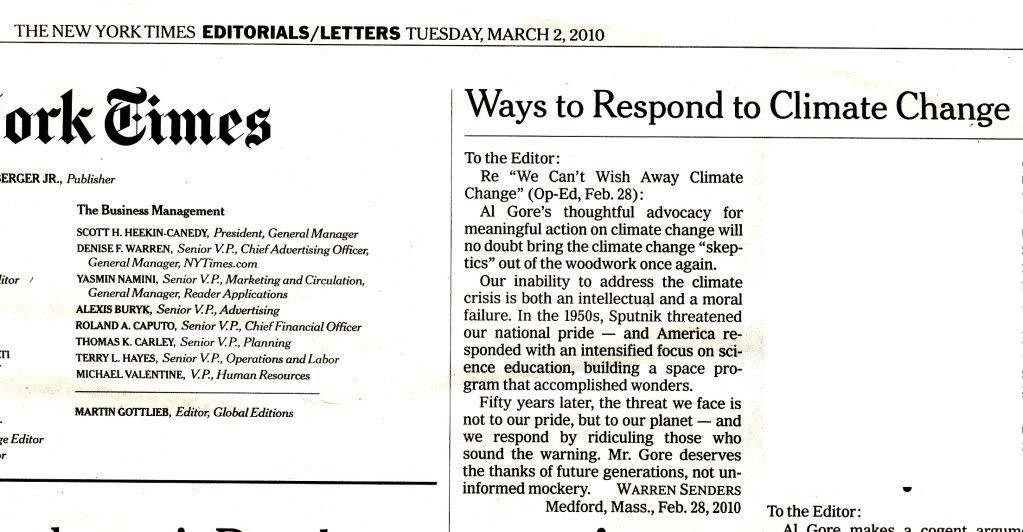
The Boston Globe:
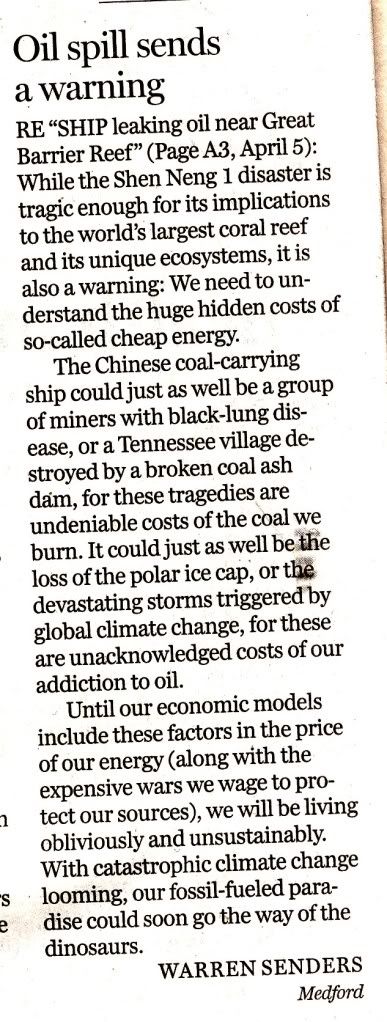
Two letters to the Medford Transcript:
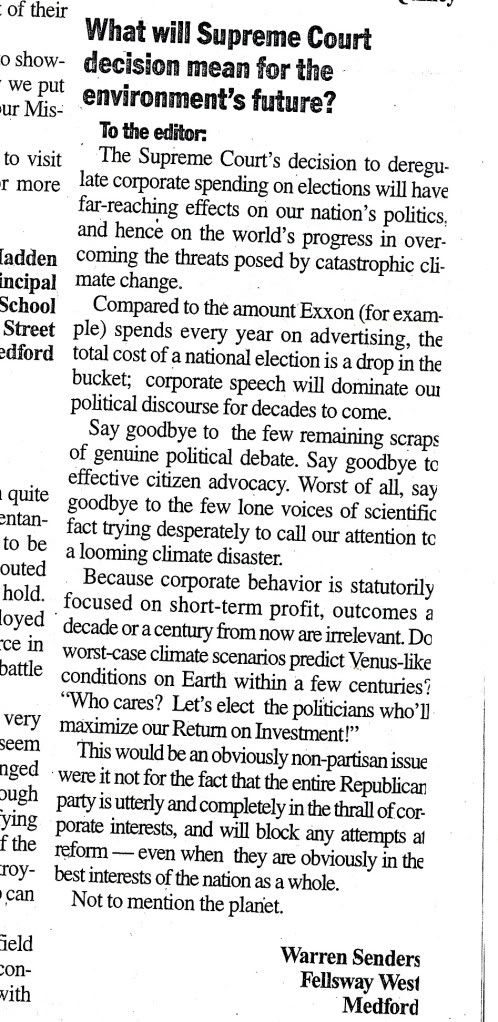
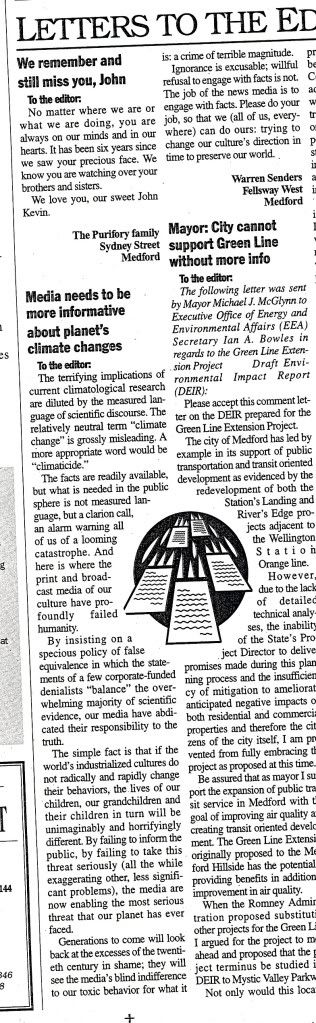
Fifi? Fifi? Oh, my god, Fifi!
My mother gets the Amherst Bulletin every week, and when we go to visit her, I always turn eagerly to the police report section. Not because there are interesting crimes, but because I might get to read stuff like this:

India Indian music music: genius khyal Ramakrishnabua Vaze
by Warren
2 comments
Meta
SiteMeter
Brighter Planet
Ramakrishnabua Vaze: Raga Mian Ki Malhar
As promised long ago, here is the full-length version of Vazebua’s Mian ki Malhar. The two khyals are both classics; the vilambit is Karim naam tero; the drut Bolare papihara.
The accompanists are both superb. Sarangi is provided by Ustad Bundu Khan, playing his special small humaniform sarangi; tabla is by a young Ustad Alla Rakha. Vazebua was in his eighties, so there are moments when his intonation loses focus or his breath control gives out before his idea has been resolved, but these are minor quibbles…the performance as a whole is riveting, the last recorded testament of one of the form’s greatest masters.
All India Radio Recording: Raga Mian Ki Malhar
Pandit Ramakrishna Vaze
Rajeev Vaze, Bua’s great-grandson, commented on one of the earlier posts:
I would like to elaborate on couple of things in line with my comment that ‘Bua was much ahead of his times’. He was one of the first musicians and possibly the only one, who published books on many compositions with notation, which he acquired from his Gurus by way of extreme hard work. The idea behind this was to throw open his stores to every follower of music. There are many books written by estiblished musicians thereafter but all those are without notations and the students can not gain anything except the literature.
You will also realise that not many stalwarts were mentally prepared to cut records under the pretext that their music will become common and thereby loose its value. Realising the importance of documentation and it’s usefulness for generations to come, Buwasaheb not only mastered the art of modulating his voice so as to suit the recording machines available in those days but tried to present different facets such as Thumari, Tarana, Bhajan along with the khyal on the number of records being cut.Unfortunately, all his deciples died at a very young age and most of them such as Master Deenanath, Keshaorao Bhosale, Bapusaheb Pendharkar belonged to Theatre. His work is not known to present generation. I’ve seen many people sing / like compositions from dramas such as ‘Sanyasta Khadga’, ‘Shah Shivaji’ etc with a wrong presumption that these are composed by Master Deenananth. This is incorrect as all these and many more are composed by Buwasaheb. There are many songs composed by Pt Hridaynath which are based on the original compositions of Vazebua and the listeners are still enjoying.
environment Politics: financial reform Harry Reid
by Warren
leave a comment
Meta
SiteMeter
Brighter Planet
Month 4, Day 20: Their Cash, Our Trash
A version of yesterday’s letter, this one to Harry Reid.
Dear Majority Leader Reid,
As financial reform legislation comes to the floor of the Senate, it’s important to recognize that the gutting of America’s economy is deeply and powerfully linked with the destruction of America’s environment. Irresponsible short-term thinking, motivated entirely by considerations of immediate profit, is at the root of both our financial crisis and our climate emergency.
Only a vigorous regulatory regime can keep giant corporate interests from exploiting legislative loopholes to the detriment of our financial and environmental health. Economically and environmentally destructive behavior is rooted in a systemic bias toward short-term economic thinking. As long as it is based on a model of unregulated consumption, our economy will remain unsustainable. Big banks buying and selling incomprehensible credit derivatives; cheap plastic junk that winds up in oceanic garbage patches — this is the face of unrestrained and short-sighted consumption, and it’s profoundly damaging to our country and to the world.
We need our corporations to focus on long-term thinking, something which is currently discouraged by the terms of corporate charters. We only have a little time left to determine whether we will leave our descendants a meaningful future or an exploitative dystopia. To fix the climate, we must transform our economy, making it essential that the largest economic forces in the country give back more to the Earth than they take out.
We can’t afford to lose this one.
Yours Sincerely,
Warren Senders
environment Politics: Chris Dodd economy financial reform John Kerry
by Warren
leave a comment
Meta
SiteMeter
Brighter Planet
Month 4, Day 19: Turning Your Money Into Trash
Financial reform is very important, not only because Goldman Sachs and the rest of the shark pack have ripped the guts out of our economy, but because these mega-bankers care as much about the environment as they do about the people below them on the economic ladder. That is to say, not at all. Unsustainable environmental practices go hand in hand with unsustainable business practices, and it’s time to make sure that shit is absolutely never going to happen again.
Dear Senators Kerry and Dodd,
This letter is about the connection between climate legislation and financial reform.
Any reasonably robust climate bill will be fought tooth and nail by business interests in this country, which is a sure indication that environmental legislation needs to be coupled with financial reform. Ultimately, our destruction of the environment is rooted in a systemic problem in our economic thinking. Our economy is largely built on an unsustainable practice: buying things and turning them into trash as quickly as possible. This happens on Wall Street when the big banks buy and sell incomprehensible credit derivatives to one another, and it happens on Main Street when our stores sell us cheap plastic-wrapped junk that breaks and winds up in a landfill a week later.
An economic model based on turning things into trash will ultimately destroy our nation, and us along with it. We tell our children to contribute to society, to leave things better than we found them — but unless we can end our reliance on consumption as a way of life, our fine words are nothing more than hypocritical prating. The next few decades will determine whether we live in a world that offers our children and their children a meaningful future or a landscape clogged beyond recognition with toxic trash. We can’t fix the climate unless we transform our economy — until we focus our power and attention on living in ways that give back more to the Earth than we take out.
During the debate on the financial reform bill, it is my hope that you will point out to your colleagues in the Senate (and to the nation) that what unsustainable financial practices have done to our economic health, unsustainable consumption habits are doing to our environment. Our nation, and the world, can afford this no longer.
Yours Sincerely,
Warren Senders
environment: allergens hay fever
by Warren
leave a comment
Meta
SiteMeter
Brighter Planet
Month 4, Day 18: More “Allergy” Stuff
U.S. News and World Report had a little squib about the same report referenced two days ago — all about how there were going to be a lot more allergens in the air, so allergy sufferers were going to be even more miserable than they usually are.
I shortened and revised my earlier letter, and used their dedicated submissions form to send it in.
It’s not just the eyes and noses of allergy sufferers that will be hit by global warming. Allergies and asthma are already huge loss factors almost everywhere in our economy: 12 billion dollars and 14 million school and work days to hay fever alone; $15 billion in medical costs and $5 billion in lost earnings a year to asthma. If, as scientists predict, climate change doubles or triples the level of ragweed allergens in our air, the economic effects are going to be disastrous.
On the other hand, antihistamine manufacturers will be excellent investment opportunities; we’ll be able to sneeze all the way to the bank.
All joking aside, this is just one tiny aspect of the most serious threat humanity has ever faced. We must take strong action to reduce greenhouse gas emissions, or it’s going to hurt a lot more than our noses.
Warren Senders
environment Politics: Barack Obama National parks teddy roosevelt
by Warren
leave a comment
Meta
SiteMeter
Brighter Planet
Month 4, Day 17: National Park POTUS
RL Miller writes about President Obama’s approach to our national park system, and provides me with fodder for a letter. Too tired to write eloquently; I’m falling asleep at the keyboard.
Dear President Obama,
It was great to learn of your memorandum addressing “America’s Great Outdoors Initiative.” It is crucial that we as a nation learn to conserve our land and natural resources, integrating state, local, and tribal leadership with federal support and partnerships. Most important for those of us who pay attention to news on climate issues is your commitment to “use science-based management practices to restore and protect our lands and waters for future generations.” That’s good news; science-based management is reality-based management, something the previous administration could have used a lot more of.
While it’s absolutely crucial to build conservation initiatives from the local level up, the role of the federal government is crucial. Teddy Roosevelt, as you remarked, made America’s national park system into one of our greatest resources, and he did it through decisive use of the powers of the federal government; while his use of the Antiquities Act in creating national monuments was criticized as socialistic (sound familiar?), his bold vision preserved the Grand Canyon.
The input of local residents is important — but familiarity may breed contempt, leading locals to take a priceless national resource for granted. By all means, talk with local residents, but remember that they’re citizens of a nation. Bold and resolute action in the conservation of our natural resources is essential.
Most important for the long run is to restore a love of the land and the environment to the American people. We should expand our National Park system, increase hiking trails and allocate federal funds for schoolchildren’s field trips up the mountains. Many city dwellers have no access to our beautiful open spaces, and children especially suffer terribly from “nature deprivation syndrome.”
If we are to have a hope of addressing the terrible threat posed by global climate change, we must make it possible for every citizen to know and love our country’s natural resources. While they are vital for tourism, and for their own intrinsic beauty, our national parks and forests are also part of the struggle against climate change: they’re “carbon banks,” capturing carbon in the form of trees, keeping it from entering the atmosphere. Trees and forests are our first line of defense against global warming, which is why it’s crucial that all proposals for acquiring wilderness must be evaluated on the carbon absorption of the land — its carbon footprint.
The damage that has already been done by political pandering to crass anti-environment interests is incalculable. For the sake of our parks, our forests, our country, our citizens and our planet, I hope your words about “science-based management practices” are matched by your actions.
Yours Sincerely,
Warren Senders