environment Politics: corporate irresponsibility denialists economics media irresponsibility
by Warren

leave a comment
Meta
SiteMeter
Brighter Planet

Year 2, Month 12, Day 19: Hey, I Just Heard They’re Selling iPads For $19.95!
Mike Tidwell analyzes the gloom in the Baltimore Sun, with an op-ed called “The hottest issue: Climate change dwarfs other problems.” Not much to add to this:
An optimist might want to raise a glass as 2011 winds down. U.S. troops will be out of Iraq by New Year’s Eve. The global AIDS pandemic is ebbing. And the U.S. unemployment rate dropped by nearly half a percent in November.
But an optimist would have to totally ignore one really important number to maintain the cheer. That number is 11. It was tossed out by scientists and economists at the international climate talks that just ended in Durban, South Africa.
If we human beings continue to torch fossil fuels — oil, coal, natural gas — without any serious limitations in the next few decades, our planet could warm a full 11 degrees Fahrenheit by 2100. That was the message from the highly respected International Energy Agency in a report just released in Durban.
How much is 11 degrees of warming? For help, let’s inventory the warming we’ve already seen on our planet. Already, the Arctic Ocean has lost 40 percent of its ice mass since the 1970s. Already, wildfires in the American West destroy six times more forest land per year than 40 years ago. Already, the biggest hurricanes come more frequently, and the city of Virginia Beach is starting to plan a methodical retreat from its shoreline due to sea-level rise. Already, Allstate insurance company won’t issue any new homeowners policies in coastal Maryland and Virginia because of stronger storms.
And how much warming did it take to trigger all of the above? How much to trigger the extreme floods and droughts and heat waves from China to Australia to Texas that scientists say are connected to climate change?
Answer: 1.4 degrees Fahrenheit.
I’m gloomy today. Wonder why? Sent December 15:
The climate-transformed planet of 2100 offers, as Mike Tidwell states, little reason for optimism. Further gloom is warranted by the fact that a plurality of Americans have been egregiously misled by the industry-fueled message of triumphant consumerism and climate-change denial prevalent in our media. In the fantasy land inhabited by conservative denialists, the notion of climate change as a liberal conspiracy to enact a one-world government (forced re-education camps for SUV owners!) is more likely than the greenhouse effect, a scientific theory which has been verified repeatedly over the years since its discovery almost two hundred years ago.
In a political culture obsessed with short-term gain and empty symbolic gestures, the systemic changes necessary for the survival of our species (and the countless others sharing our planet) will never be discussed, let alone implemented. Too risky; too costly; too boring. Let’s go to the mall instead — there’s a sale!
Warren Senders
environment Politics: denialists idiots Republican obstructionism
by Warren
leave a comment
Meta
SiteMeter
Brighter Planet
Year 2, Month 12, Day 18: You Know What Your Problem Is? Your Problem Is That You Don’t Play In The Middle Of The Beat.
The National Post (Canada) offers a forum to a not-completely-insane conservative named Ken Silber, who lives in a dreamworld where GOP voters can be persuaded by appeals to reality:
I have drafted a speech that may help some current or future GOP candidate achieve all of the above. Any candidate who wishes to use the following material is more than welcome:
My fellow Republicans,
I am a conservative and I believe that facing up to reality is essential to conservatism. Today I outline how I will lead our nation in addressing a difficult and complex – but very real – problem. That problem is climate change, and specifically the global warming that is being caused by humanity’s use of fossil fuels such as coal and oil.
There is ample evidence that global warming is happening and that human activities are the key factor causing it. Scientists overwhelmingly agree the temperature rise is real. Moreover, they have examined possible factors ranging from volcanoes, to the sun’s fluctuations to cosmic rays that bombard the Earth from space. There is a strong scientific consensus that fossil fuels are the main cause – as pumping car-bon into our atmosphere creates a greenhouse effect that traps the sun’s energy and heats the Earth.
Science never gives us absolute certainty, but the real uncertainties here are about the future. We do not know how fast temperatures will rise over decades, or the full effects this will have on our world. We do know that the risks are great – for example, large sections of American farmland becoming unusable, coastal cities flooding, 100-plus-degree heat waves, massive wildfires and other extreme events becoming common.
We must address those risks but not by weighing our economy down with taxes and regulations. On the contrary, a dynamic free-market economy is crucial to limiting the risks and managing the effects that do occur. My plan does not involve picking winners among energy companies and technologies with subsidized loans. Nor is it a capand-trade scheme that includes handing out credits to the politically connected. And for that matter, I note that President Obama never actually managed to bring a climate-change plan to a vote in Congress.
My plan is straightforward and honest. We will raise taxes on carbon emissions across the board, while cutting taxes on payrolls and incomes. That means more money in people’s pockets, and more incentives for industry to develop cleaner and safer energy supplies.
Wow. What can you say to that? Here’s what I sent them on December 14:
Ken Silber’s almost-but-not-quite advocacy of a fee-and-dividend approach to reducing carbon emissions is a rare manifestation of sanity in the bizarre world of conservative science denial. The problem isn’t with taxing CO2 — an eminently workable idea that has won the approval of experts from all sides of the ideological spectrum — but with the notion that there are enough conservatives left who actually care what scientists and economists have to say.
For decades, conservatives have employed the language of anti-intellectual American exceptionalism: only liberals pay attention to eggheads. This approach, refined through many electoral generations, has succeeded in producing an entire political demographic that regards measurable reality (all those boring statistics) as the exclusive province of liberals — that is, anathema.
Just as his party’s rank-and-file reject humans’ role in global warming, Mr. Silber cannot accept conservative ideology’s role in making a political environment hostile to science and factuality.
Warren Senders
humor Jazz music Personal Warren's music
by Warren
leave a comment
Meta
SiteMeter
Brighter Planet
environment Politics: Durban Conference media irresponsibility
by Warren
leave a comment
Meta
SiteMeter
Brighter Planet
Year 2, Month 12, Day 17: Sparkly!
Eugene Robinson tries to make it shiny in the Washington Post:
I’m inclined to believe that the apparent result of the climate change summit in Durban, South Africa, might turn out to be a very big deal. Someday. Maybe.
After the meeting ended Sunday, initial reaction ranged from “Historic Breakthrough: The Planet Is Saved” to “Tragic Failure: The Planet Is Doomed.”
My conclusion is that for now, at least, the conceptual advance made in Durban is as good as it gets.
This advance is, potentially, huge: For the first time, officials of the nations that are the biggest carbon emitters — China, the United States and India — have agreed to negotiate legally binding restrictions.
The thing is, when there’s stuff like this showing up in the news, there’s no wiggle room left for the world’s nations to eventually maybe someday get around to kinda sorta consider possibly doing something.
Sent December 13:
Our nation’s ongoing disconnect between political and factual reality is perfectly exemplified in Eugene Robinson’s attempts at an optimistic assessment of the Durban agreement. Yes, it’s nice that many nations have signed a new treaty, but the bad news has, so to speak, circled the globe before the good news has even gotten out of bed.
In the empirically verifiable world of scientifically confirmed facts, the window for avoiding catastrophic climate change is closing far more rapidly than any experts were predicting. In the non-linear world of American governance, though, kicking the can down the road is a perfectly adequate substitute for action — because politics, the “art of the possible,” makes action impossible. Remember the recent story of rural firemen watching a house burn to the ground because the homeowner hadn’t previously paid a $75 fee? Will commitment-averse politicians ensure that we all likewise become spectators at our own immolation?
Warren Senders
environment Politics: Durban Conference idiots Republicans scientific consensus
by Warren
leave a comment
Meta
SiteMeter
Brighter Planet
Year 2, Month 12, Day 16: It’s 20-20, All Right.
REPORTING FROM WASHINGTON — Negotiators at a climate change meeting in South Africa struck an 11th-hour deal to avoid the collapse of international negotiations over global warming, averting the worst fears of environmental advocates but doing little to immediately advance the cause of limiting greenhouse gas emissions.
The agreement in effect would postpone new concerted global action on climate change for at least eight years. However, given the political realities, particularly in the United States and China, the accord probably offered the best chance to move the process forward, analysts said.
The mood at the United Nations gathering in Durban was somber as the talks ended just before dawn Sunday, participants said, largely because many questions remained unanswered and the risk of a catastrophic increase in global average temperature had not been reduced.
Under the deal, nations committed themselves to talks aimed at reaching a legally binding agreement by 2015 that would limit emissions of carbon dioxide and other gases that contribute to global warming. The limits would not go into effect until 2020 at the earliest.
Decrying the oppositional nature of these two cultures is an easy way out, but I don’t mind. Sent December 12:
Political and scientific realities are entirely different. Politics, the “art of the possible,” deems the recent agreement from the Durban climate conference to be a triumph — the result of tremendously difficult and complex negotiations, one that offers participating nations, and the world, a best way forward. Scientists, on the other hand, concern themselves with measurable facts and their implications — and the details of the general scientific consensus on climate change suggest that Durban’s “best way forward” is virtually certain to be too little, too late.
It’s time for a reality-based politics to emerge in our nation and the world. The fact that Republican presidential candidates can gratuitously dismiss scientific expertise should be a red flag: ideologies that must reject facts in order to survive cannot be successful in the long run — for in the long run, the laws of physics and chemistry will win. They always do.
Warren Senders
environment Politics: corporate irresponsibility Durban Conference
by Warren
leave a comment
Meta
SiteMeter
Brighter Planet
Year 2, Month 12, Day 15: Okay, Okay. I Promise I’ll Call The Doctor. Next Week, Though. Not Now. I’m Too Busy.
Good news! The patient has consented to think about going into treatment, maybe, perhaps, in a few years. USA Today:
DURBAN, South Africa (AP) – A U.N. climate conference reached a hard-fought agreement Sunday on a complex and far-reaching program meant to set a new course for the global fight against climate change for the coming decades.
The 194-party conference agreed to start negotiations on a new accord that would put all countries under the same legal regime enforcing commitments to control greenhouse gases. It would take effect by 2020 at the latest.
The deal also set up the bodies that will collect, govern and distribute tens of billions of dollars a year for poor countries. Other documents in the package lay out rules for monitoring and verifying emissions reductions, protecting forests, transferring clean technologies to developing countries and scores of technical issues.
Currently, only industrial countries have legally binding emissions targets under the 1997 Kyoto Protocol. Those commitments expire next year, but they will be extended for another five years under the accord adopted Sunday — a key demand by developing countries seeking to preserve the only existing treaty regulating carbon emissions.
Recycling the “hindsight is always 20-20” line. Sent December 11:
Yes, it’s good news that the world’s nations have agreed to a deal on greenhouse gas emissions. But the outcome of the Durban Conference is hardly cause for exuberance. Scientific evidence of the threat posed by global climate change is mounting faster than the glaciers are melting, and the overwhelming consensus is that humanity — not just America, China and India, but all of us, everywhere — has less than five years to act decisively before environmental tipping points are passed, propelling us into a far less friendly future.
The Durban agreement will come into effect at the beginning of the next decade — several years too late. Climatologists have been telling us for decades about the dangers of a runaway greenhouse effect; we cannot say we weren’t warned. If we fail to act dramatically and quickly, the old cliche, “hindsight is always 2020” will acquire a new and grimmer meaning.
Warren Senders
environment Politics: corporate irresponsibility Durban Conference incompetence Todd Stern
by Warren
leave a comment
Meta
SiteMeter
Brighter Planet
Year 2, Month 12, Day 14: Maybe It’s Because I’m A Cow
The Grey Lady analyzes why things don’t work:
DURBAN, South Africa — For 17 years, officials from nearly 200 countries have gathered under the auspices of the United Nations to try to deal with one of the most vexing questions of our era — how to slow the heating of the planet.
Every year they leave a trail of disillusion and discontent, particularly among the poorest nations and those most vulnerable to rising seas and spreading deserts. Every year they fail to significantly advance their own stated goal of keeping the average global temperature from rising more than 2 degrees Celsius, or about 3.6 degrees Fahrenheit, above preindustrial levels.
There is no denying the dedication and stamina of the environment ministers and climate diplomats who conduct these talks. But maybe the task is too tall. The issues on the table are far broader than atmospheric carbon levels or forestry practices or how to devise a fund to compensate those most affected by global warming.
{snip}
Effectively addressing climate change will require over the coming decades a fundamental remaking of energy production, transportation and agriculture around the world — the sinews of modern life. It is simply too big a job for the men and women who have gathered for these talks under the United Nations Framework Convention on Climate Change, the 1992 treaty that began this grinding process.
There was a Gary Larson cartoon showing a jazz band in a club. Standing on the bandstand is a figure holding a saxophone, saying something like, “look fellas, it’s just not working. Maybe it’s the tempo, or maybe it’s the changes, or maybe it’s because I’m a cow.” Sent December 10:
While the task of reining in global greenhouse emissions is indeed an enormously daunting one, the alternative is inaction, which (although excellent for the oil industry’s profit margins) is unacceptable for the majority of the world’s people. The failure to achieve any substantive agreement at Durban is hardly surprising, given the degree to which American government has been so thoroughly co-opted by corporate interests.
Meaningful action on climate must be polycentric, operating on scales of size from individuals to nations; it must also be polytemporal, reflecting both long- and short-term thinking. We all have individual parts to play — but in the global arena, our wholly-owned government can no longer be presumed to have our interests at heart. The petroleum industry’s disproportionate influence on our political system has made America’s intransigence a worldwide embarrassment. In the machinery of climate negotiations, oil is not a lubricant, but a hindrance to progress.
Warren Senders
Jazz music Personal photoblogging: genius
by Warren
5 comments
Meta
SiteMeter
Brighter Planet
More Jazz Photoblogging: Sam Rivers Trio, Boston, 1976
I digitized a lot of photos over the past year, but I haven’t gotten around to putting them online. Here are some pictures from a wonderful performance by Sam Rivers’ Trio at the Jazz Workshop. Most of these were woefully underexposed; some parts of the images were restored digitally.
While I don’t feel these are my best work they nonetheless capture some of the ambience of the gig that night. Not bad for a high-school student.
Sam Rivers is a truly amazing musician who is still going strong. Here is his website.

Sam Rivers

Dave Holland
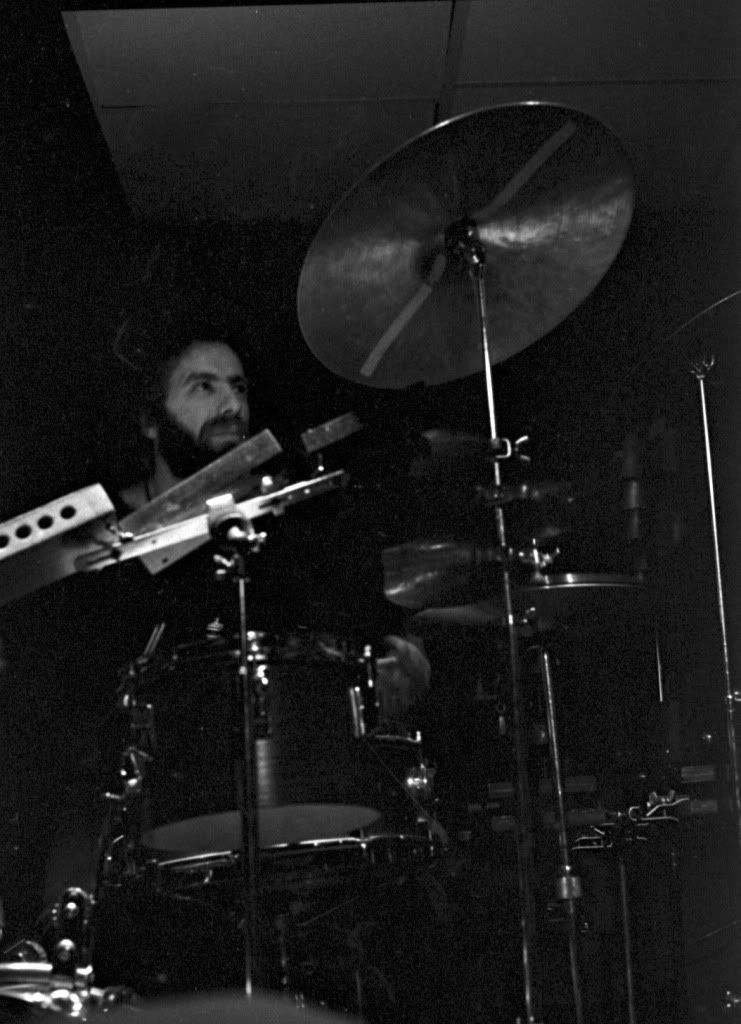
Barry Altschul
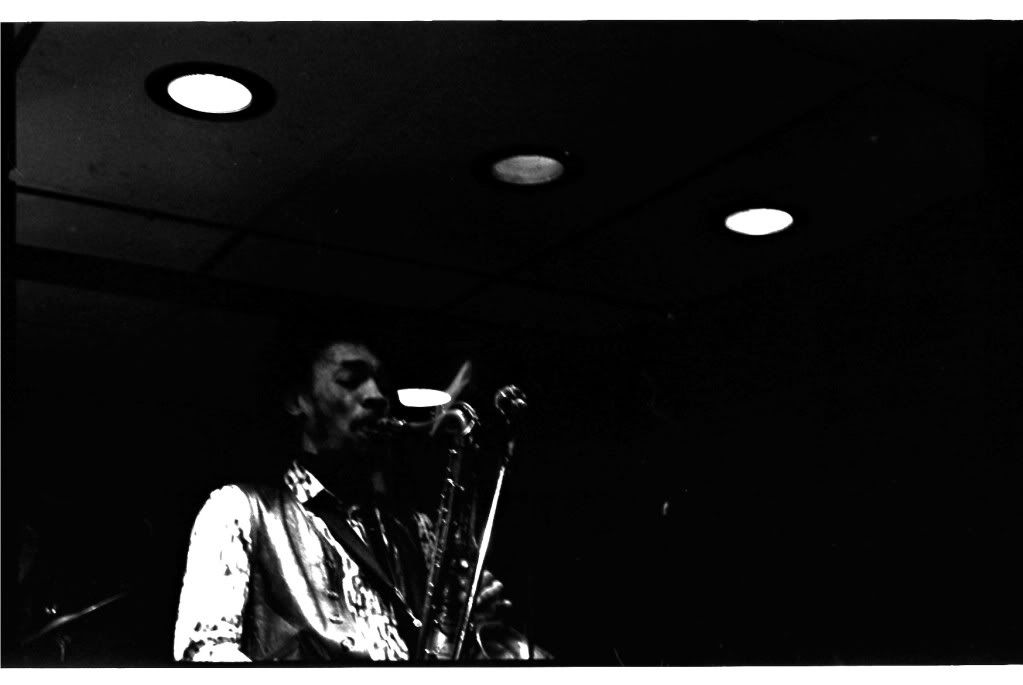
Sam Rivers
environment Politics: denialists Durban Conference idiots
by Warren
leave a comment
Meta
SiteMeter
Brighter Planet
Year 2, Month 12, Day 13: First Off, I Didn’t Borrow It. Second, It Was Broken When You Gave It To Me. And Third, I Fixed It Before I Brought It Back.
New York’s Murdoch outlet runs a fairly even-handed report on the Durban Debacle:
World climate talks are on the brink of failure as several of the largest polluters — including the United States — could block attempts to save the only treaty on governing global warming.
The 194-nation UN climate conference in Durban, South Africa, is scheduled to end later Friday after two weeks of tense negotiations.
Under the proposed deal, the European Union would extend its pledge to reduce its greenhouse gas emissions under the 1997 Kyoto Protocol.
In exchange, other countries would have to promise to negotiate another deal that would include legally binding obligations for every nation — not just for the wealthy, industrialized countries who initially approved the Kyoto Protocol.
The European Union has also maintained it will not renew its pledge, which expires next year, without agreement to begin work to compel all countries to curb their emissions, including the U.S., China and India.
The comments, as usual on Murdoch-owned outlets, are a great outpouring of stupid. Sent December 9:
The scientific evidence confirming the rapid warming of Earth’s atmosphere is growing faster than the glaciers are shrinking. In consequence, the paranoids who once theorized that global temperature measurements were part of a giant liberal conspiracy have retreated; their new position is that while the planet is indeed getting hotter, humans aren’t responsible.
Once the nay-sayers absorb the massive amounts of evidence for human causes of climate change, they’ll assert that climate chaos can only be solved by “the power of the free market,” presumably including tax cuts for the wealthiest 1%.
Let’s review: first they claimed it wasn’t happening; now they claim humans didn’t cause it. The denialists were wrong then, they’re wrong now, and they’ll be wrong in the future. So why are they still determining American environmental and energy policy? The US should lead the world in coping with climate change, not stand in the way of progress.
Warren Senders
environment Politics: Durban Conference heroes Todd Stern
by Warren
leave a comment
Meta
SiteMeter
Brighter Planet
Year 2, Month 12, Day 12: Oh, To Be Twenty-One Again
I have a new hero, Ms. Abigail Borah. The Washington Post:
Todd D. Stern, the Obama administration’s special envoy for climate change, was put on the defensive by a narrative developing here that the United States opposed any further action to address global climate disruption until after 2020, when the 1997 Kyoto Protocol, a primary United Nations climate agreement, and voluntary programs negotiated more recently will have run their course.
He firmly denied that the United States was dragging its feet and, somewhat ambiguously, endorsed a proposal from the European Union to quickly start negotiating a new international climate change treaty.
Mr. Stern’s statement to delegates from more than 190 nations at the annual climate conference was disrupted by a 21-year-old Middlebury College junior, Abigail Borah, who told the assembly that she would speak for the United States because Mr. Stern had forfeited the right to do so.
“I am speaking on behalf of the United States of America because my negotiators cannot,” said Ms. Borah, who is attending the conference as a representative of the International Youth Climate Movement. “The obstructionist Congress has shackled justice and delayed ambition for far too long. I am scared for my future. 2020 is too late to wait. We need an urgent path to a fair, ambitious and legally binding treaty.”
Scores of delegates and observers gave her a sustained ovation. Then the South African authorities threw her out of the conference. “That’s O.K.,” Ms. Borah, who is from Princeton, N.J., said later by telephone. “I think I got my point across.”
Let’s hope so. The “hindsight is always 2020” line came courtesy of Sven Eberlein. Sent December 8:
If Todd Stern’s assertions about an international agreement on greenhouse emissions are to be believed, our nation’s chief climate negotiator may have had his eyes opened a bit by the opposition he’s encountering at the Durban conference. By now, the scientific evidence cannot be ignored, and the picture isn’t a pretty one: while the epiphenomena of rapidly increasing climate change imperil us all, the United States has abdicated its responsibilities to the international community and abandoned all pretense of world leadership on what is arguably the most crucial issue of our time.
Let us hope Mr. Stern’s vision has been cleared by his encounter with far-sighted protesters like Ms. Abigail Borah. If we must wait another nine years for an agreement to restrict greenhouse emissions, it will be too late, and the old saw that “hindsight is always 2020” will have taken on a newer and far more tragic meaning.
Warren Senders